


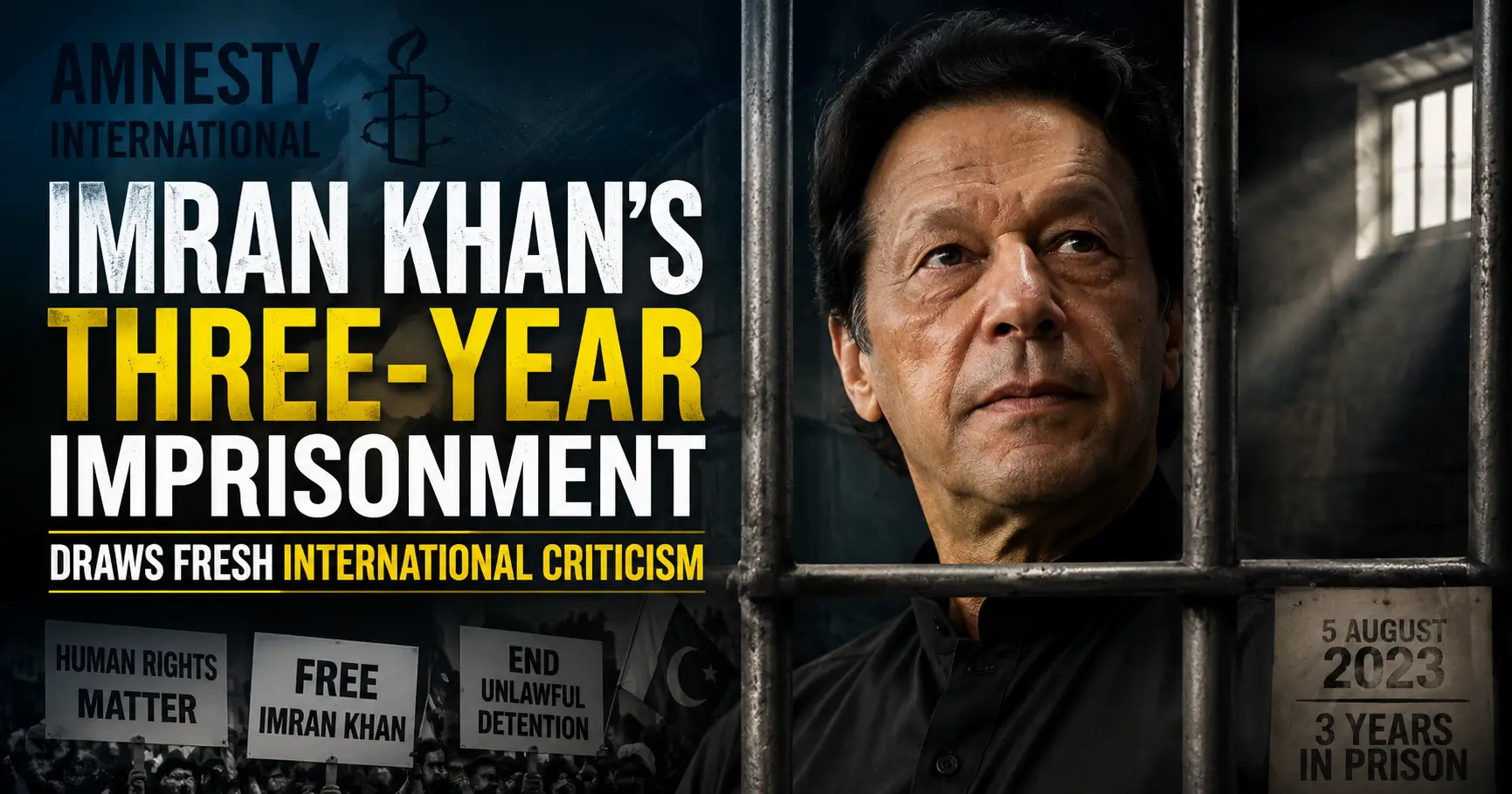
Human rights organizations have once again appealed to Pakistan’s authorities to allow them to give ex-prime minister Imran Khan access to his family, lawyers, and medical treatment, since Khan finished three years behind bars yesterday.
Amnesty International called on the administration to stop what it described as \”unlawful\” Khan's detention restrictions. They demanded the Pakistani authorities to restore right away and freely the right of Imran Khan and his wife, Bushra Bibi Khan, to meet their families and lawyers.
In a statement released before the anniversary of Khan's imprisonment, Amnesty International said that Khan and his wife need medical treatment and that the government should end their solitary confinement soon, stating that such a measure would be a violation of international law.
Lassee Isabelle, Amnesty International’s acting regional director for South Asia, stated that the authorities in Pakistan have constantly, during the past three years, hindered Imran Khan's right to a fair trial by keeping him in a prolonged solitude in a cell and restricting visit and hospitalization to the family.
She said that it has become known, reportedly, that he hasn't been able to make contact with any member of the family in over eight months, and his vision has also deteriorated significantly. Both Imran and Bushra according to her words have not had regular contact to lawyers since December 2025.
Imran Khan's political party, Pakistan Tehreek-e-Insaf (PTI), also mentioned the situation by saying that the former Prime Minister has been completely cut off by his imprisonment from the outside world with not a single visitor during the last eight months.
Sayed Zulfikar Bukhari, the man from the family of a senior person very close to Imran Khan, voiced his concern regarding the present conditions on his post to the X platform. His post states that both Khan and his wife should have a fair trial, that the basic prisoners' rights they are guaranteed, and that their predicament seems to be a very sad one.
Bukhari was asked in an interview, “After three years, what did Pakistan get out of it?” By doing that he made an argument that was in favor of Pakistan's political and social issues.
He said, “What have these three years accomplished anyway? Has Pakistan actually made headway in any sector or been worse off? Imran is currently more widely supported than at any previous time and the people of Pakistan are fully aware how they have been a reason for his struggle and a democratic Pakistan at the very least despite many hardships he goes through.”
Amnesty International also encouraged Pakistani authorities to respect the right of peaceful assembly before demonstrations that Khan’s fans, relatives, and other PTI members have planned on the occasion of the first anniversary of his incarceration. The organization asked for no reoccurrences of what it called illegal and arbitrary methods used against protesters.
During her third year in custody, concerns for the health of Maryam Nawaz continued. Earlier in the year, she was diagnosed with blockage of the retinal vein in one eye, a potentially serious cause of visual loss.
Nawaz's lawyers pointed out that the delays in medical treatment only served to reduce the visibility in the one eye to nearly 15 percent of the normal one. Still later on, a medical board set-up by the Pakistani government noted that the former prime minister's condition had improved significantly.
During January – June, Nawaz underwent five retinal injections at a public hospital. Nonetheless, their loved ones insisted with the authorities for their personal consultants to look at them as soon as possible.
Ever since early August 2023, the 72-year-old politician who was the first lady as the Pakistan's Prime Minister has not been free of custody. This was after an anti-Government protest movement that had rocked Pakistan in May earlier of that particular year.
Before getting the boot, Ms.Nawaz had a very successful career as a professional lady cricket player. In April 2022, a vote of no-confidence passed in the Lower House of the Parliament removed her from her position.
On the lighter side, Ms.Nawaz was cleared for not having committed a major part in many famous trials, including that of a case she was a defendant in, involving official secrets and her marriage with Bushra Bibi. However, she is currently jailed over a corruption case for 14 years and that one sentence cannot be appealed. Also both she and her husband got more years in December 2025 in another case dealing with state gifts.
The two sentences are both subject to appeal, and Nawaz has maintained her innocence.
The meanwhile, her sister, Aleema Nawaz, was busy visiting different cities/towns of Khyber Pakhtunkhwa to seek the people's support for the march planned to be on the 5th of August outside Adiala Jail where the one who was the former prime minister is now a prisoner.
Some of the global organizations are also worried about a woman's being kept in custody. In 2024, the UN Working Group on Arbitrary Detention said that, to its knowledge and experience, Pakistan's imprisonment of the woman had been done against people's right to personal security, and that her holding was an arbitrary one.
A little after, the UN Special Rapporteur on Tortures said the ways in which the woman and her husband who are both in Pakistani detention were being treated do not conform with the world's standards.
The UN torture rapporteur, Ms Alice Jill Edwards, a year ago has strongly expressed her view to the State of Pakistan to stop treating a political figure and a former prime minister, Mr Imran Khan's wife the person in question here (Maryam Nawaz), inhumane. She told them that she had been confined to almost total isolation for 33 months (i.e., from August 2018 to July 2021) under constant surveillance from cameras.
The state of Pakistan has not in any way accepted or agreed with the accusations that Ms.Nawaz (Maryam) has been abused.
It would recall in 2024 a government representative, a senior Pakistan authority, had provided to the Supreme Court information on Ms Nawaz imprisonment conditions with the express intent of refuting allegations that it was done through an inescapable solitary confinement without allowing any access to a lawyer.
Based on materials shared with Reuters, that filing was accompanied by photos of the prison room of a Ms.Nawaz where one can discern not only books of the government's choice for prisoners but also an entire collection of books that Ms Maryam Nawaz had read over the years including Nelson Mandela's famous biography “Long Walk to Freedom”; the caption says that these photos were evidence of the government's efforts to provide the political dissident with reading books of her choice.
Copies of the filing also stated the names and pictures with Ms. Nawaz of close relatives, friends of hers, lawyers as well as the members of a party who have visited Ms Nawaz since her being jailed in 2023.
In government's submission photos, the prisoner's modest room was illustrated with items such as a study table, one chair, single bed, air cooler, washbasin, a washroom inside the room, and a television wall unit.
Besides that, images showed his closet with hangars, Khan was allowed to walk in a covered corridor twice a day which is reflected in the photos, a separate kitchen filled with essential supplies, books about Islam, history and politics in the shelves, and a room with an exercise bike and fitness gear.
Even after the imprisonment for three years, Imran Khan remains the most important political personality in Pakistan.
The experts are convinced that his continued imprisonment has enhanced his popularity, especially for the youth of Pakistan who increasingly see him as a representative of the resistance against the military presence in politics.
Salman Rafi Sheikh from Lahore University of Management Sciences told Nikkei Asia that for many Pakistanis, particularly youth, Imran Khan stands for resistance to military interference and their detention can only confirm this view.
Sheikh also remarked that his reported refusal of any deal on his liberation is consistent with that portrayal.
“Making a compromise”, he pointed out, “will undermine his claim that the cause of Pakistan's democrat crisis lies in the unelected military ruling civilians politics”.
CSS Forum – Join Now
