


The Iran war has run a live audit of the American arsenal. The example of Interwar Britain shows how little time there is to change course.
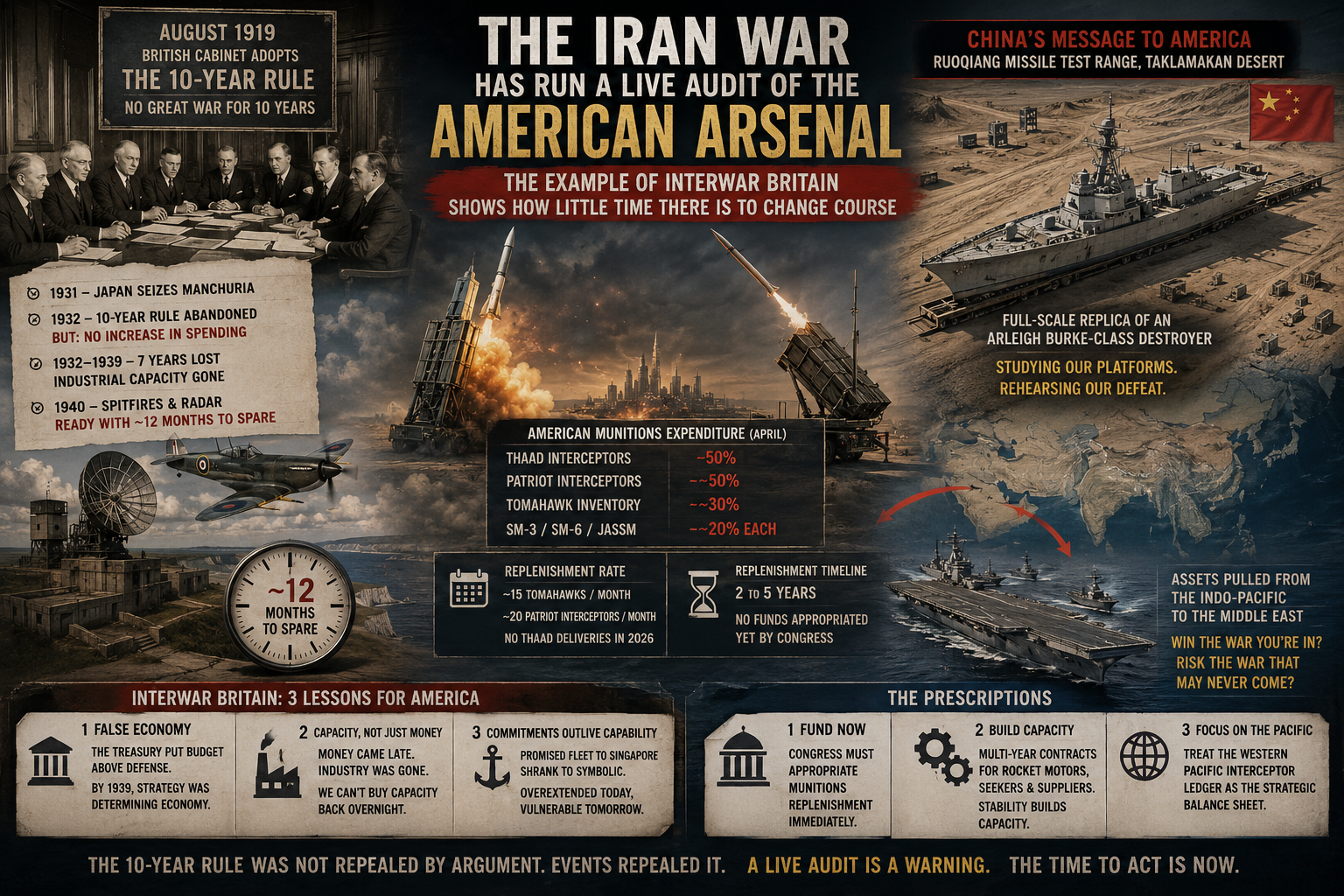
In August 1919, the British Cabinet instructed its defense departments to plan on the assumption that the empire would fight no great war for 10 years. The 10-Year Rule, renewed annually and made self-perpetuating in 1928, was a fiscal device dressed as a strategic judgment. This allowed the Treasury to balance budgets while the arsenal that had won World War I quietly dissolved.
After Japan seized Manchuria in 1931, the rule was finally abandoned the following year. The Cabinet added a caveat: ending the rule must not be taken as justification for increased defense spending. Britain then spent seven years discovering that money appropriated late cannot buy back industrial capacity surrendered earlier. The Spitfires and radar stations that saved the country in 1940 were ready with roughly 12 months to spare.
The United States has been living under its own 10-Year Rule for three decades. The post-Cold War assumption was never written down so bluntly. Still, it governed procurement all the same: wars would be short, precision would substitute for mass, and munitions lines could idle at minimum sustaining rates because stockpiles would never be drawn down seriously. The war with Iran has now run a live audit of that assumption, and the audit has returned a failing grade.
The numbers are not classified guesses. By the time full-scale fighting paused in April, the Pentagon had expended at least half of its THAAD interceptors, nearly half of its Patriot interceptors, and roughly 30 percent of its Tomahawk inventory, according to a CSIS analysis that officials familiar with internal Defense Department estimates confirmed. Stocks of SM-3, SM-6, and JASSM each fell by roughly a fifth. With the ceasefire now collapsed and strikes resumed, expenditure is climbing again. Replenishment is where the story darkens.
Current delivery schedules provide roughly 15 new Tomahawks and 20 new Patriot interceptors per month, with no THAAD deliveries forecast in 2026. Former Pentagon comptroller Elaine McCusker estimates replenishment timelines of two to five years for most munitions. And as retired Major General John Ferrari has noted, Congress has not yet appropriated a single dollar to replace a single missile.
Interwar Britain is the closest historical analog we have to a maritime democracy in exactly this position, and the parallels deserve to be taken seriously.
First, the Treasury argued through the 1930s that economic stability was itself the “fourth arm of defence.” Britain would win a long war through superior staying power, so nothing in rearmament could be allowed to compromise the budget, the value of the pound, or the export trade. The argument was not foolish. It was the intellectual ancestor of every modern claim that industrial mobilization must wait its turn behind budget caps and continuing resolutions.
But the verdict of historian GC Peden in Arms, Economics and British Strategy on where the doctrine ended is the one that matters. By 1939, the situation had inverted, and military strategy was determining economic policy rather than the other way around. Events, not planners, decided when the doctrine expired. The Iran War is America’s inversion point. Washington has not yet noticed.
Second, when Britain finally opened the fiscal tap after 1936, money was not the problem. Industrial capacity was. Skilled labor, machine tools, and a government policy of non-interference with normal civilian trade throttled output regardless of appropriations, and the policy of protecting business as usual was not abandoned until the German Anschluss with Austria in 1938. The modern rhyme is precise. The Tomahawk line produces around 90 missiles per year, against a promised production upgrade to 1,000. Existing precision-strike missile contracts extend deliveries to 2029.
The production of interceptors depends on critical minerals such as gallium and germanium, whose supply chains run through China. Washington could quadruple the budget tomorrow. The missiles would still arrive in 2029. Money moves faster than industrial capacity, which is why the decision to build capacity cannot wait for the war that requires it.
Third, Britain planned for two decades to send a main fleet to Singapore in the event of a Japanese attack. As German and Italian naval building consumed the Royal Navy’s margin, the promised fleet shrank from adequate to symbolic. By mid-1939, the Admiralty was debating whether two capital ships might be spared. The strategic commitment outlived the overextended capability behind it.
Artificial Intelligence (AI)Military Administration
Why the US Should Embrace ‘Techno-Strategic Power’
Technological changes will give an edge to defense-oriented, flexible, and scalable capabilities.
Nikolas K. Gvosdev August 7, 2026
DiplomacyHistory
Could Immanuel Kant Solve Kaliningrad?
Königsberg’s philosopher of peace has much to teach a world on the brink of war.
Parag Khanna August 7, 2026
Today’s version is visible in plain sight. Carriers, destroyers, and interceptor inventories have been pulled from the Indo-Pacific to the Middle East, and the administration has accepted the risk on a stated theory: win decisively the war you are in rather than hoard capability for a war that may never come. That is a defensible theory. It is also, almost word for word, the reasoning British governments applied to Japan in the 1920s, when war in the Far East seemed remote enough to discount. The war that may never come has a habit of arriving on the schedule of the adversary who watched you spend your margin.
Which brings us to the adversary. This summer, satellite imagery revealed that China has built a full-scale, three-dimensional replica of an Arleigh Burke-class destroyer at the Ruoqiang missile test range in the Taklamakan Desert, detailed down to the superstructure and radar profile of a Flight IIA or Flight III ship. It sits among earlier carrier mockups and rail-mounted moving targets, surrounded by the debris of previous missile tests.
The purpose is not mysterious. The People’s Liberation Army (PLA) is refining the kill chain against the exact class of warship that has spent this year launching Tomahawks into Iran. Beijing is studying American expenditure rates in real time and rehearsing against American platforms at leisure. There is no better single image of the current moment: the United States emptying its magazines in the Middle East while China builds targets shaped like the ships that carry them.
An honest version of this argument has to meet the strongest objection, because Interwar Britain supplies that too. Critics of appeasement long insisted Britain should have rearmed years earlier, but earlier rearmament would have bought obsolete equipment. The Fairey Battle bomber, ordered in bulk to hit numerical targets, was known to be unfit for purpose even as production continued. The Spitfire and the radar chain could not have been built in 1934. The modern analog writes itself: perhaps surging Tomahawk and Patriot production locks in yesterday’s munitions on the eve of a drone and hypersonic revolution, and the smarter play is to wait for the next generation.
The objection deserves a direct answer. Magazine depth is not an airframe. Interceptors, cruise missiles, and the solid rocket motors beneath them are valuable across nearly every scenario the United States can face, and the production capacity that builds them is the same capacity that will build their successors. Britain’s mistake was not building the wrong fighters in 1934. It was maintaining an industrial base so thin that even the right fighters arrived with 12 months to spare. The lesson is to buy capacity, not merely inventory.
Britain got its year of grace because Hitler moved on his timetable rather than Britain’s, and because an Expeditionary Force could be improvised while the Channel held. The United States has no English Channel in the Pacific and should not plan on the grace period. The prescriptions follow from the diagnosis. Congress must appropriate munitions replenishment now, as the first order of business, not as a rider on the next supplemental.
The Pentagon must contract for capacity, with multi-year procurement commitments that give solid rocket motor and seeker suppliers a reason to invest, the same demand stability the shipbuilding industrial base has needed for a decade. And planners must treat the Western Pacific interceptor ledger as the strategic balance sheet it is, because Beijing already does.
The 10-Year Rule was never repealed by argument. Japanese aggression repealed it, and even then the Treasury fought a seven-year rearguard action against the implications. The Iran War has now repealed America’s version. The only open question is whether Washington spends the next seven years the way London spent 1932 to 1939, arguing about affordability while the adversary built, or whether it treats a live audit as the gift it is: a warning delivered while there is still time to act on it.
About .the Author: Christopher Carroll
Christopher Carroll is a shipbuilding policy analyst for Systems Planning and Analysis; his views are his own. He holds a Master of Public Policy from the Pepperdine School of Public Policy, where his capstone research examined the reindustrialization of the American shipbuilding base. His writing has appeared in RealClearDefense, AllSides, and the publications of the American Society of Naval Engineers
https://nationalinterest.org/feature/americas-10-year-rule-just-ended
CSS Forum – Join Now
