


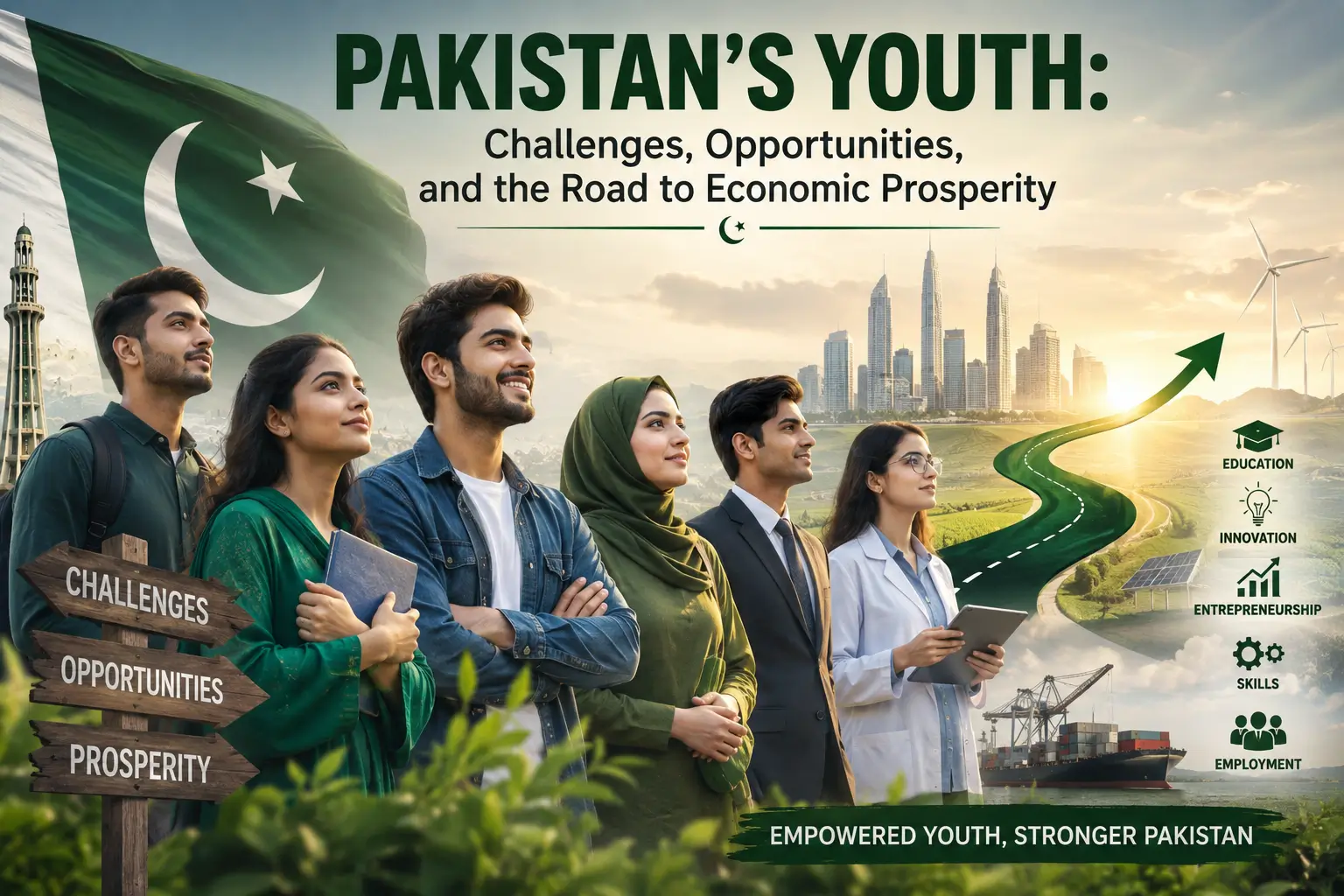
According to the United Nations Population Fund (UNFPA), approximately 64 per cent of Pakistan’s population is under the age of 30, while an estimated 65-70 million people fall within the 15-29 age group (UNFPA, 2023). This large youth population provides Pakistan with a unique opportunity to accelerate economic growth, increase innovation, and improve global competitiveness. However, if these young people remain unemployed or underemployed, they could instead contribute to rising poverty, social instability, and increased migration.
Despite their enormous potential, Pakistani youth face numerous challenges. The most pressing issue is unemployment and underemployment. Every year, hundreds of thousands of graduates enter the labour market, yet the economy fails to generate sufficient quality jobs. Many graduates also discover that their academic qualifications do not match employers’ expectations. Consequently, even highly educated individuals often struggle to secure suitable employment (World Bank, 2025).
Every year, hundreds of thousands of graduates enter the labour market, yet the economy fails to generate sufficient quality jobs.
Several structural factors contribute to youth unemployment in Pakistan. Economic growth has remained inconsistent, limiting industrial expansion and private-sector investment. Political uncertainty, inflation, energy shortages, and inadequate investment in research and innovation further discourage job creation. Moreover, Pakistan’s education system continues to emphasise theoretical knowledge rather than practical and market-oriented skills. Weak collaboration between universities and industries leaves many graduates unprepared for the rapidly evolving demands of the labour market (International Labour Organisation [ILO], 2024).Pakistan regional tours
Another challenge is the changing aspirations of young Pakistanis. Previous generations often viewed government employment as the safest career option. Today’s youth, however, increasingly seek financial independence, flexible working conditions, international careers, entrepreneurship, and digital employment opportunities. Social media, remote work, freelancing platforms, and global connectivity have significantly altered career preferences. Many young people now aspire to become entrepreneurs, software developers, content creators, digital marketers, or freelancers instead of pursuing conventional office jobs.
Rapid technological advancement has also reshaped the global employment landscape. The World Economic Forum identifies artificial intelligence (AI), big data, cybersecurity, cloud computing, software engineering, digital marketing, renewable energy, robotics, and data analytics among the fastest-growing employment sectors worldwide (World Economic Forum, 2025). These trends indicate that future employment opportunities will increasingly favour individuals possessing technical expertise, digital literacy, creativity, and problem-solving abilities rather than relying solely on traditional academic qualifications.Connecting South Asians
Consequently, Pakistani youth should prioritise acquiring skills that are in high demand both domestically and internationally. Degrees in computer science, software engineering, information technology, artificial intelligence, cybersecurity, data science, finance, accounting, engineering, nursing, pharmacy, and allied health sciences continue to offer strong employment prospects. However, degrees alone are no longer sufficient. Employers increasingly value practical experience, internships, communication skills, teamwork, English language proficiency, and digital competence alongside formal education.
Vocational and technical education also deserves far greater attention. Unfortunately, technical careers often receive less social recognition than university degrees in Pakistan. Yet globally, skilled professionals such as electricians, welders, plumbers, HVAC technicians, industrial mechanics, heavy equipment operators, caregivers, and construction supervisors are in exceptionally high demand. Countries including Saudi Arabia, the United Arab Emirates, Qatar, Germany, Canada, Australia, and several European nations actively recruit technically trained workers due to labour shortages in these sectors. Proper vocational training can therefore provide Pakistani youth with stable incomes both at home and abroad.
Pakistan’s growing digital economy presents another promising avenue for employment. The country has emerged as one of the leading freelancing nations in the region. Thousands of Pakistani freelancers provide software development, graphic design, digital marketing, content writing, video editing, translation, virtual assistance, and consulting services to international clients through online platforms. This sector allows skilled individuals to earn foreign exchange while working remotely from Pakistan. According to the Pakistan Software Export Board (PSEB), expanding digital exports and IT-enabled services continue to create significant employment opportunities for educated youth (PSEB, 2025).
Entrepreneurship represents another critical pathway toward economic prosperity. Instead of waiting for government jobs, young people should be encouraged to establish startups and small businesses. Pakistan offers considerable opportunities in e-commerce, agribusiness, food processing, education technology, healthcare services, tourism, renewable energy, logistics, software development, and creative industries. Government-supported incubation centres, startup accelerators, access to finance, and business mentorship can significantly improve the survival and growth of youth-led enterprises.Pakistan regional tours
At the same time, universities must redefine their role. Higher education institutions should move beyond awarding degrees and focus on producing employable graduates. Academic curricula need continuous revision in consultation with industries to ensure relevance to labour market demands. Mandatory internships, industry placements, entrepreneurship education, AI literacy, digital skills, critical thinking, leadership development, and project-based learning should become integral components of university education. Career counselling centres should also guide students toward emerging professions rather than oversaturated disciplines.
Government policy must complement these educational reforms. Expanding industrialisation, improving the investment climate, supporting export-oriented industries, strengthening vocational education, encouraging technology parks, and promoting digital entrepreneurship can substantially increase youth employment. Public-private partnerships should be strengthened to align education with workforce requirements.
Economic prosperity for Pakistani youth will ultimately depend upon a combination of personal initiative and institutional support. Young people should diversify their income sources through freelancing, entrepreneurship, investments, and continuous skill development rather than relying exclusively on traditional employment. At the same time, policymakers, educational institutions, industries, and financial organisations must collaborate to create an ecosystem that rewards innovation, productivity, and talent.
Pakistan stands at a historic crossroads. Its youthful population can either become its greatest economic asset or its greatest developmental challenge. Countries that successfully invested in their youth transformed themselves into global economic leaders within a generation. Pakistan possesses the human capital necessary to achieve similar success. By equipping its young people with relevant education, future-oriented skills, entrepreneurial opportunities, and access to global labour markets, the country can convert its demographic advantage into sustainable economic prosperity. The future of Pakistan will ultimately be determined not by the size of its youth population, but by how effectively it prepares its youth to compete, innovate, and lead in an increasingly knowledge-driven global economy.
SOURCE:https://dailytimes.com.pk/1537172/pakistans-youth-challenges-opportunities-and-the-road-to-economic-prosperity/
CSS Forum – Join Now
