


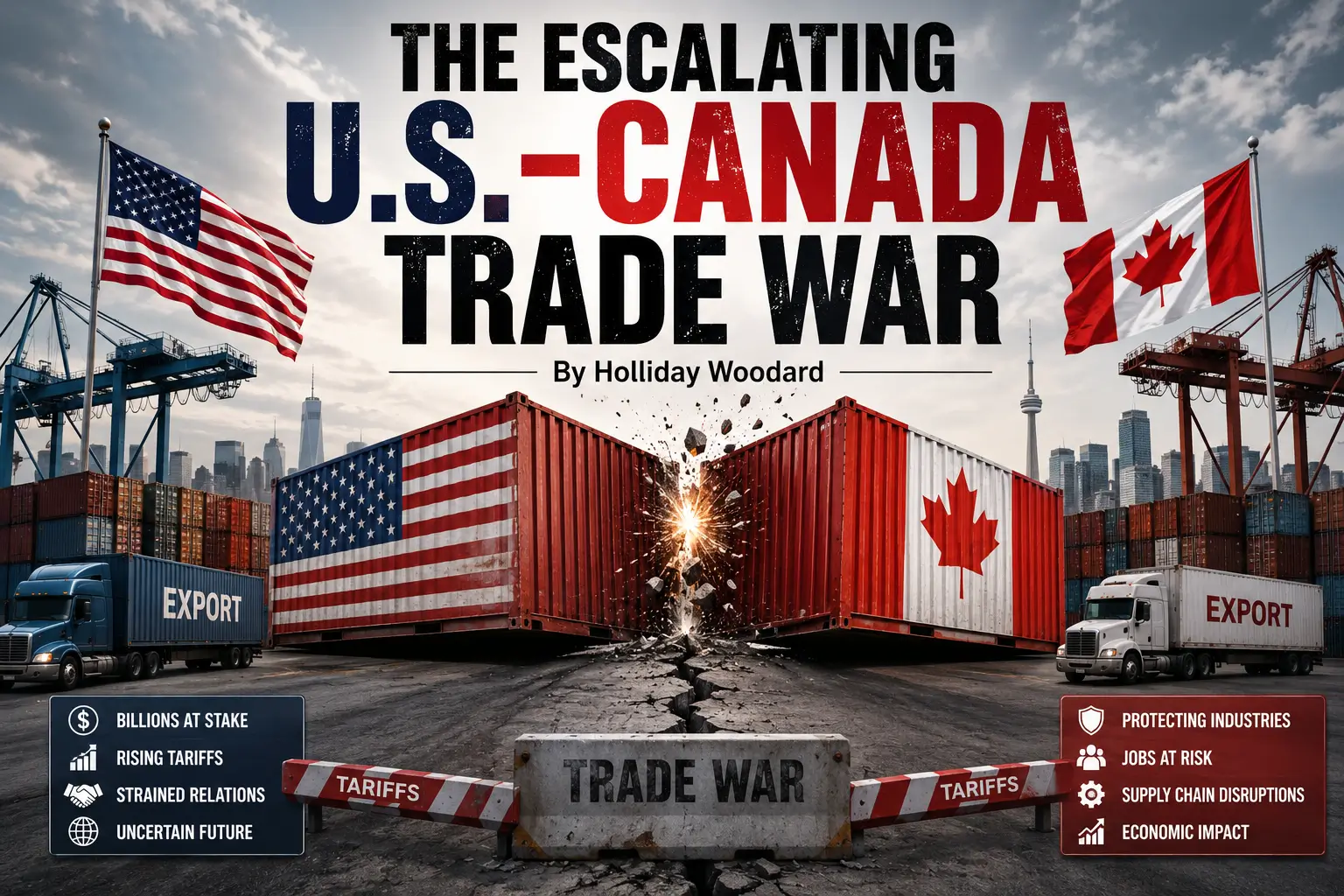
Canada on Tuesday announced retaliatory tariffs of up to 50% on some 700 U.S. imports worth roughly $20 billion – the latest salvo in an escalating trade war after negotiations collapsed over U.S. demands and steep new U.S. tariffs on Canadian goods.
In an address to the nation, Canada Prime Minister Mark Carney said he stepped away from a “bad deal” and promised that Canada would defend itself and match the U.S. tariffs “dollar for dollar.”
“We were attacked. You’re at war when you get attacked. We got attacked,” Carney said Saturday, a day after talks collapsed.
Tensions between the neighboring countries have grown steadily during President Donald Trump’s second term. Trump has repeatedly targeted Canada with tariffs and suggested publicly that the country should become the 51st state. Trump as recently as Monday derisively referred to Canada’s prime minister as “Governor Carney,” and Vice President JD Vance also on Monday insisted he had made a “Freudian slip” during remarks in which he referred to Canada as a “state.”
“The attitude at the negotiation table, that Canada is a subsidiary of the United States,” Carney said, “that’s not something we’re going to accept.”
Here is what to know about the U.S.-Canada trade war.
Why Did Trade Negotiations Collapse?
The negotiations fell apart late Friday when last minute American demands forced Canada to suspend talks.
Carney said the terms were “unfair, uneconomic and called into question the reliability of any deal.”
The failure stemmed from several points of contention. Officials also hit a snag over metals and autos tariffs as well as whether the Keystone XL pipeline – meant to transport oil from Canada to the U.S. Gulf Coast – would be reopened. U.S. negotiators also demanded that Ottawa roll back the promotion of Canadian content in online streaming services and even weaken French-language protections.
“At the end of the day, this trade war is going to become the Netflix war,” Barry Appleton, the co-director of the Center for International Law at New York Law School said.
The U.S. also wanted Canada to align its international tariff policies with the U.S. When the U.S. changed its tariff policy toward a country, Canada would be expected to do the same.
Commerce Secretary Howard Lutnick was reported to have intervened, suggesting lower tariffs for certain amounts of aluminum and refusing to lower tariffs on heavy trucks – a product Canada is known for producing.
“We cannot accept what they offered and we will not give what they asked,” Carney said. “We were not prepared to compromise Canada’s sovereignty or undermine our key industries.”
Which Goods Are Targeted by the New 50% Tariffs?
Normally, the United States-Mexico-Canada Agreement allows goods to cross neighboring countries duty-free. But with the trade agreement currently under renegotiation, goods that follow production rules are no longer automatically exempt from tariffs.
“These combined 60% tariffs deviate sharply from the duty-free treatment that U.S. importers and downstream buyers have come to expect for most Canadian goods since NAFTA came into effect in the 1990s,” Augustine Lo, partner of international law firm Dorsey & Whitney, said.
Americans bought $382 billion worth of products from Canada last year. The new 50% U.S. tariffs apply to $20 billion worth of those goods.
The list includes more than 500 products targeting a variety of industries – forestry, dairy, clothing and alcohol products are all on the list. Many tariffs target products of small businesses like honey. As a result of the failed talks, the 50% tariff on auto, aluminum and steel industries remain.
Trump excluded oil, gas, fertilizer and most minerals – which dominate Canada’s exports – from the tariff war.
Taking effect on Sept. 8, the policy mirrors the American tariffs on Canadian goods, including doubling the U.S steel and aluminum tariffs to 50 percent.
Carney's list affects $20 billion of imports from the U.S. the same as the Canadian exports on the Trump-imposed tariffs. The affected products range anywhere from household products like aluminum foil to steel bridges and consumer products like dishwashers, washing machines and stoves. Frozen and fresh fish also make up a chunk of the list.
What Do the Tariffs Mean for the U.S. and Canada?
The tariffs will be damaging for both countries.
“The U.S. is Canada's biggest customer,” Appleton says. “You don't want to piss off your biggest customer. By the way, Canada is the U.S. biggest customer too.”
Since the tariffs are already in effect, Canada will feel the impact first. As a smaller, export-dependent economy that sends over 70% their exports south, reducing American buyership can hurt market sales, risk layoffs and slow down Canada's economy.
Because American companies pay U.S. tariffs to import Canadian goods, it is likely that prices will rise for everyday shoppers – including for items like toilet paper.
“Remember during COVID, everybody started going crazy. But there was no reason to go crazy for toilet paper,” Appleton says. “Now there's a reason to go crazy for toilet paper.”
The situation could escalate further if Trump responds to Canada's retaliatory measures.
Under section 338 of the Tariff Act, the president has the power to block Canadian goods if Canada discriminates against U.S. commerce, according to Appleton. Canada can also push back, including putting an export tax on petroleum in the Midwest – where Canada is a major gasoline source. Such a move may raise gas prices ahead of midterm elections.
“Trade wars always escalate, and they never get better until the very end,” Appleton says.
SOURCE:https://www.usnews.com/news/national-news/articles/2026-08-25/the-escalating-u-s-canada-trade-war
CSS Forum – Join Now
