


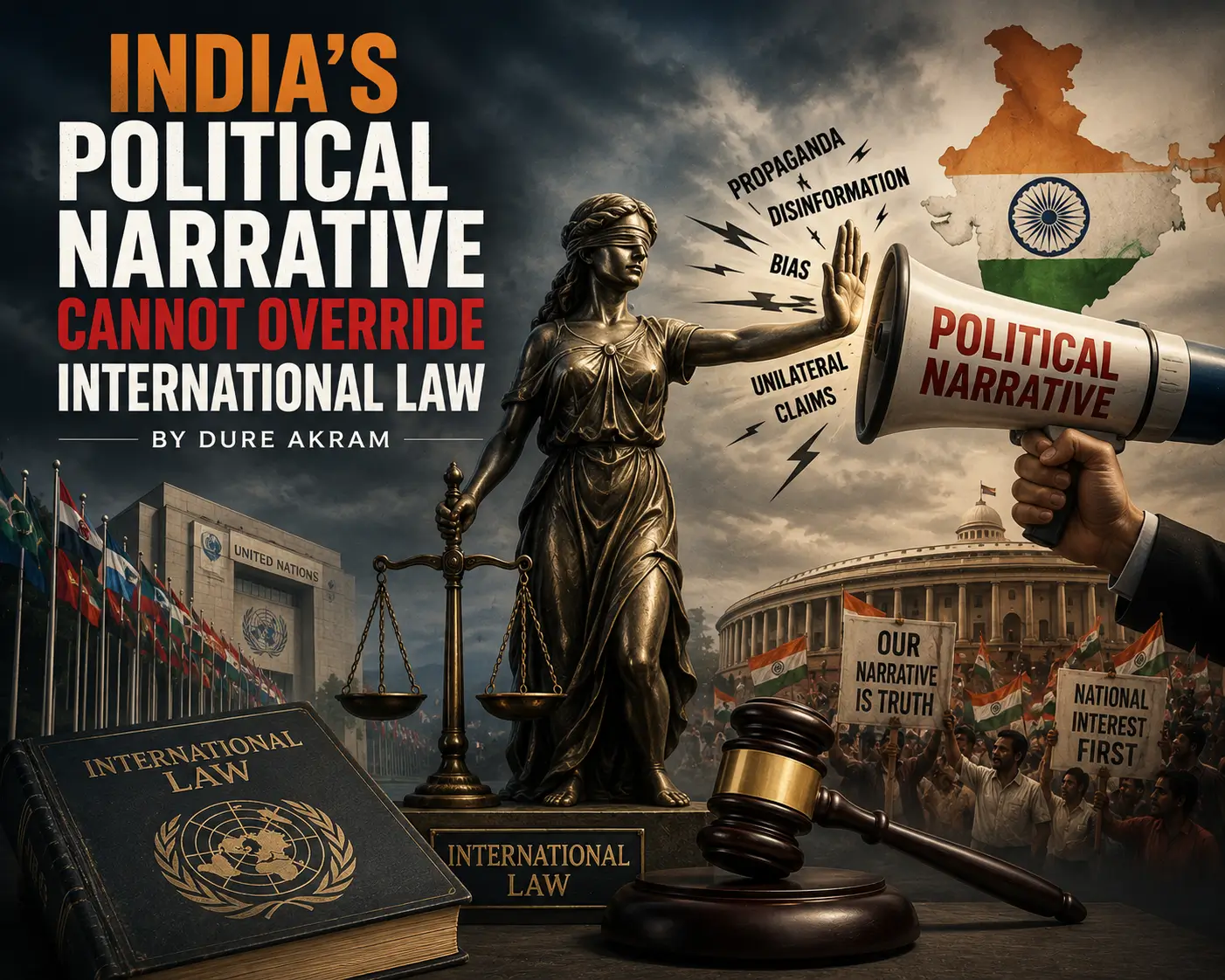
There is a fundamental problem with Indian Ambassador Vinay Mohan Kwatra’s defence of keeping the Indus Waters Treaty in “abeyance:” the political argument has moved considerably further than the law permits.
Kwatra argued that Pakistan had destroyed the goodwill underpinning the treaty long before India formally set it aside, pointing to terrorism, wars and Pakistan’s repeated challenges to Indian hydropower projects.
It is an effective political narrative precisely because it combines several separate grievances into one indictment. Ironically, it is much less convincing as an explanation of what India is legally entitled to do under the treaty. International agreements do not normally survive for 66 years because the parties remain friends. They survive because obligations are intended to endure changes in governments, crises and political relations. That distinction is particularly important in the case of the IWT because India and Pakistan have spent most of its existence disagreeing about matters far more serious than water.Exploring Travel Maps
International agreements do not normally survive for 66 years because the parties remain friends
Kwatra places considerable emphasis on the treaty preamble, which records the desire of the two governments to delimit their water rights “in a spirit of goodwill and friendship”. But the preamble cannot be read while ignoring Article XII. The same treaty published on India’s own Ministry of External Affairs website states that its provisions “shall continue in force” until terminated by a duly ratified treaty between the two governments; modification likewise requires a duly ratified bilateral agreement. The treaty contains no provision expressly authorising either party to place the arrangement in unilateral “abeyance”.
The purpose of a treaty is defeated if aspirational language about goodwill can be transformed into a continuing political condition for compliance. India and Pakistan fought a full-scale war only five years after the treaty was signed, another in 1971, confronted each other at Kargil and lived through repeated military mobilisations and terrorist attacks, yet the treaty survived because its operation was deliberately separated from the general temperature of bilateral relations. If the disappearance of goodwill were enough to erase obligations, the IWT would have ceased to exist decades ago. Its real achievement was never that it demonstrated friendship between India and Pakistan. Rather, it was that it created rules capable of functioning in the absence of friendship.Following Political News
India can, of course, advance arguments under general international law concerning suspension, fundamental changes of circumstances or countermeasures. But even on that broader terrain, New Delhi’s position is far from uncontested. In October 2025, five UN Special Procedures mandate-holders said that a unilateral treaty suspension did not appear to constitute a valid countermeasure on the information available to them, questioned proportionality because of the potential consequences for Pakistanis’ rights to water, food and livelihoods, and stressed that countermeasures are subject to procedural and substantive limitations.
Their intervention also cuts directly into the attempt to make Pahalgam a self-executing legal justification. The Special Rapporteurs unequivocally condemned the April 22, 2025 terrorist attack and demanded justice for its victims, but they separately recorded that India had not disclosed credible evidence showing that the militants who committed the attack had been sent by the Government of Pakistan. On the specific question of countermeasures, they said India had not disclosed credible evidence that Pakistan had committed the internationally wrongful act required to sustain that argument.Exploring International Relations
Pakistan will never ask the international community to treat terrorism casually because it has lost tens of thousands of its own citizens, soldiers and policemen to terrorism and has every reason to support credible attribution and prosecution wherever an attack occurs. But precisely because terrorism is so grave, responsibility cannot be established merely through accusation followed by punishment. If India possesses conclusive evidence tying the Pakistani state to Pahalgam, it should place that evidence before a credible and impartial process. Nothing of the sort has happened to this day.
The same principle applies to the water dispute. Pakistan’s resort to treaty mechanisms cannot sensibly be cited as evidence that Pakistan destroyed the treaty when those mechanisms were created precisely because the treaty’s authors anticipated disagreement. Article IX establishes a graduated dispute-resolution architecture involving the Permanent Indus Commission, a Neutral Expert and, in defined circumstances, a Court of Arbitration.
New Delhi itself invoked the Neutral Expert mechanism over technical questions concerning the Kishenganga and Ratle hydroelectric projects. Meanwhile, India’s declaration of abeyance has not caused the Hague-based process simply to vanish. The Court of Arbitration issued a supplemental award on competence in June 2025, subsequently rendered an award on general treaty interpretation, conducted another merits hearing in February 2026, heard arguments in the spring concerning interim measures and the status of the treaty, and in May issued a supplemental award dealing with maximum pondage. India rejects the legitimacy of those proceedings and has declined participation, but the legal process has continued nonetheless.Hiring Legal Counsel
International adjudication would become meaningless if a dissatisfied party could make an adverse forum disappear simply by refusing to enter the room.
Kwatra’s other major argument concerns the basic allocation of the basin. India frequently points out that the western rivers allocated principally to Pakistan carry roughly 80 per cent of the Indus system’s waters, while India received the eastern rivers carrying approximately 20 per cent.
Hydroelectric systems depend on predictable flows, irrigation authorities need advance information, and farmers at the tail end of Pakistan’s canal system can be damaged by short-term disruption even if annual totals later look less dramatic. The danger is therefore not confined to the implausible image of India turning a giant tap and permanently drying three rivers. Control over timing, storage, release patterns, project design, information and data can itself acquire strategic significance.
That was also one of the strongest conclusions from my earlier reporting on the IWT dispute. Analysts such as Michael Kugelman have correctly pointed out the physical limits of Indian leverage: India does not presently possess the infrastructure required simply to stop the western rivers at will. Environmental lawyer Ahmad Rafay Alam has similarly argued that existing infrastructure gives India control over only a limited portion of those flows. But the fact that India cannot empty the Indus does not mean Pakistan has no reason to worry about upstream manipulation. The more realistic issue is not total denial but uncertainty – and uncertainty in an irrigation economy is itself a form of vulnerability.Regional News Updates
None of this absolves Pakistan of its own disastrous record of water governance. The country leaks, wastes, over-pumps and misprices an extraordinary amount of water. The World Bank has noted that groundwater supplies more than half of agricultural water and the overwhelming majority of rural domestic supply, while over-abstraction, contamination and waterlogging threaten the resilience of the entire Indus Basin Irrigation System.
Pakistan therefore needs to fight two battles simultaneously rather than using one as an excuse to ignore the other. Internationally, it should insist on treaty compliance, transparent data, adjudication and predictable flows. Domestically, it needs modern telemetry, groundwater regulation, realistic crop choices, better storage and conveyance, provincial coordination and serious conservation.
There is also a larger Indian interest at stake that deserves more attention in New Delhi. India is itself a downstream riparian in relation to China, particularly on the Yarlung Tsangpo-Brahmaputra system, and has repeatedly sought greater transparency and hydrological information about Chinese activity upstream. The principle India would understandably want applied to Beijing is that geographic advantage does not confer unrestricted political control over a shared river. It becomes difficult to build a durable international norm around that proposition if New Delhi simultaneously argues that downstream protections in the Indus basin can be subordinated to unrelated bilateral disputes.
SOURCE:https://dailytimes.com.pk/1543797/indias-political-narrative-cannot-override-international-law/
CSS Forum – Join Now