


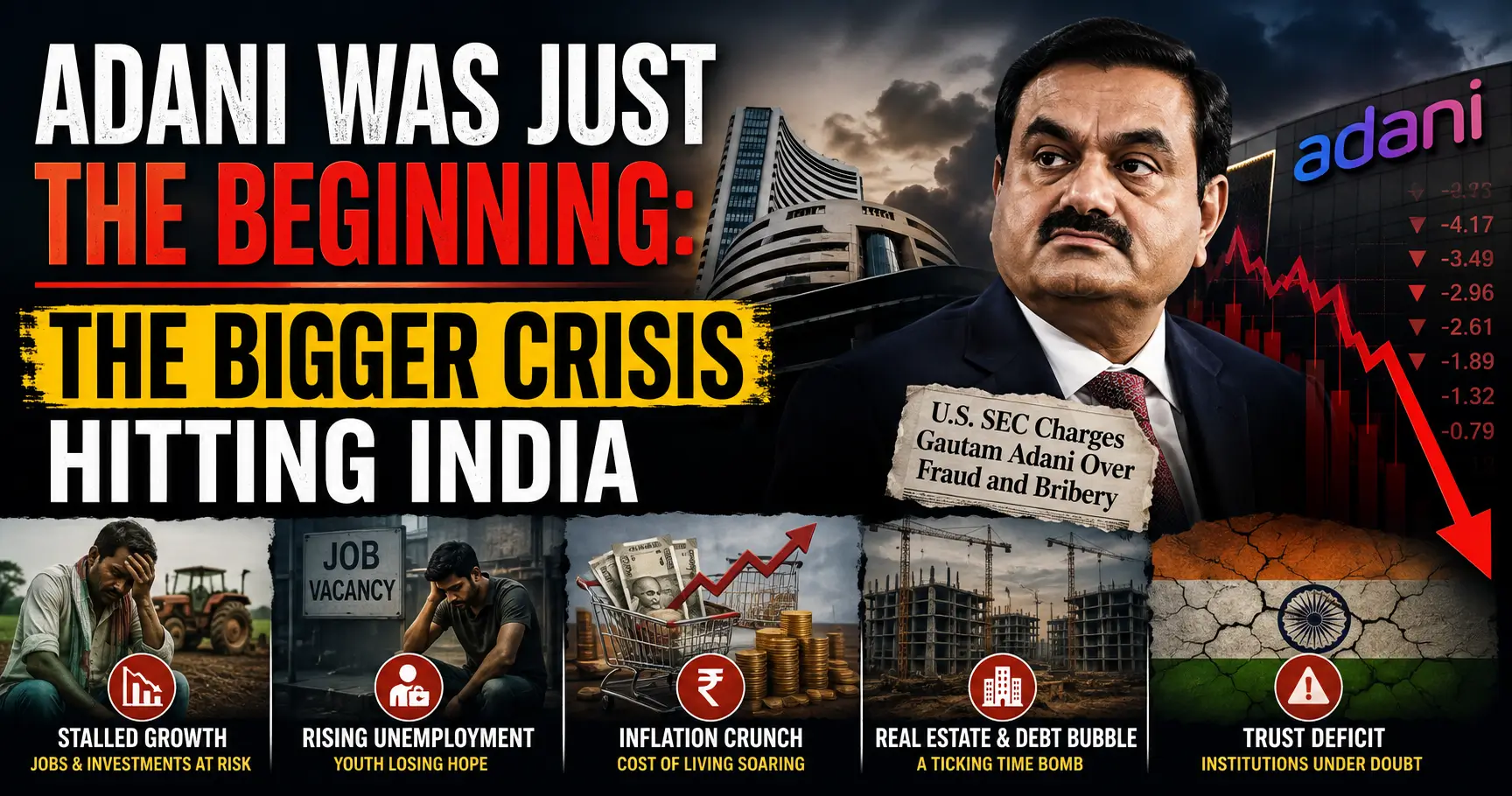
Adani Was Just the Beginning: The Bigger Crisis Hitting India
Adani Was Just the Beginning: The Bigger Crisis Hitting India On August 15, 2024, in my video (@fptalks) I spent one hour talking and then tried to post it to YouTube. It seems very mystical for me at this writing but somehow the uploading of that video from Pakistan would not be happening. So I tried with many different service providers, different VPNs, even workarounds that I thought would fix that.
After struggling for about 19 hours with different options I finally handed that video to a friend of mine who was going to a foreign country to see if that would be easier for her. She successfully posted the video there without any issues and within a few hours. Now, the video is up and called “Adani, Hindenburg, SEBI and the missing big picture” (https://www.youtube.com/watch?v=Ig3m7rcc7JE
). I present to you here a short version:
As a first move, I had been planning not to get myself mixed up with the Adani, Hindenburg and SEBI issue because that really wouldn’t make any sense considering the huge power of the Adani Group and also the Modi administration. However, when I was watching my friends in India getting stuck trying to do the story and missing time and again the main issue just because the analysis was very weak, it gradually came to me that something big was being ignored.
At the start of that year, a report by Hindenburg Research accused Adani Group of accounting fraud and inflating the company's share price. Hindenburg is known for uncovering fraud and then shorting stock to profit if the scandal affects it. The company has taken down other giant firms previously and now has launched a second batch of very grave accusations.
Anyway, beyond talking about Adani or Hindenburg, the issue has broader roots which are the worldwide economic predictions and the apprehensions about the next possible recession. Neither the American nor the European markets alone seem to have the sort of fundamental exposure that could trigger a cataclysmic collapse of world economies by themselves. Prolonged Japanese stagflation is already well known and the expectations for it have been built into the prices, and China’s weaknesses are structurally being handled by the government that can react quickly and rebalance the system pressures if need be. Adani Was Just the Beginning: The Bigger Crisis Hitting India
India is quite different in its character and the Indian economy is not going to be transparent and free of any structural weakness or contagion channels. It would be totally unrealistic to ignore the fact that there have existed huge NPAs in the Indian economy, and the former RBI chief Dr Raghuram Rajan was really trying to address the issue, but once the government has changed he was dismissed and as a result India's economy has entered into a state of very limited transparency even now.
We don't have a clear idea yet of how big that problem actually is. Adani Was Just the Beginning: The Bigger Crisis Hitting India
There is a lot of speculation going around the idea of manipulating India's economic statistics. On the one hand you're seeing reports of India's impressive growth, while on the other one you have weak employment and the living cost is an unbearable burden for both workers and the middle class. That is really why when the leaders of the political systems and strongmen rely more on ideology and displays of strength rather than economic planning they come to use false data to support their claims.
Sometimes while such huge groups as Ambani and Adani are rapidly becoming the biggest players in India's economy and national conversation, their size also brings along with it some big concerns. Of course, it cannot be taken for granted that every part of these vast business empires is good and healthy; the history of the Tata Group's internal disputes, including the death of Cyrus Mistry by suicide, should be more than sufficient to remind the world how the big players can still suffer serious failures. Adani Was Just the Beginning: The Bigger Crisis Hitting India
That is what the latest allegations from Hindenburg really show – and even raise the level more by calling our attention to the fact that the regulatory mechanisms might be weakening. SEBIS leadership in fact has faced questions of its own. Imagine that a government wants to weaken its regulatory bodies so that a favoured company is left free to do its monopoly. When a government does something to a regulatory body that makes it useless, there is no transparency. The capital markets and financiers from abroad really rely a lot on this openness. And if investors figure out that the system is broken and that they are not protected at all, the capital leaving will be so enormous that it will look like an ocean is running away. Capitalist societies are made such that western businessmen just stop their investment and move out when losing more money than possible to make a profit in the future would only be their option left to avoid exposure to a bigger financial disaster. Creating one such giant and pretending to be successful can only go so far till it finally crashes down and the wider financial world is dragged down into the crisis along with it. Adani Was Just the Beginning: The Bigger Crisis Hitting India
In the end, the concentrated corporate power of the business monopolies which are supported by the leaders of corrupt politics will also get them into trouble. And if you think that money can give you security for the time being by staying away from your responsibilities and hiding in the high towers from the ground up where others are collapsing due to the failure of civilization, then maybe you can look at at least two examples. First of all you can take Bangladesh for a look: Sheikh Hasina had been able to hold onto her position of power in quite an effective way by, besides, making her political rivals weak and then also having in her hands the appointments of the Chief Justice and the Army Chief. However, she was forced to leave the country to save herself after the people took to the streets. Adani Was Just the Beginning: The Bigger Crisis Hitting India
We can find another example through a piece of entertainment. The movie is called “Don't Look Up” that features characters representing ultra-rich billionaires alongside politicians who completely neglect the threat from a planet-killing asteroid until it's far too late to avert a disaster caused by their greed. In a similar way, they will eventually end up suffering for escaping a disaster they helped to create through their greed.
Elites will not be saved by greed as well as by self-interested behavior. So it will require them to work alongside the regulators and stop weakening the institutions set up to keep the balance, in other words, to keep the system running properly. If they do not, then the consequences will definitely fall on them. We, the older population generation, may have been quite easy-going with these goings-ons. However, youth generation would probably not sit down to take the whole thing quite similarly.
Two years after that whole thing, it was at this stage. The Adani-Hindenburg conflict was essentially a timing match for the exit of the head of the Sebi, whereas Hindenburg itself had to leave. The Adani group had been charged with bribing as they became embroiled in the scandal and the matter was escalated to U.S. Justice Department. As soon as the U.S. administration had changed hands, they made a deal to settle and all the charges were put on hold. FDI in India almost stopped. The change was drastic: in 2022-23 Net FDI inflows dropped from around US $28 billion to less than US $1 billion in 2024-25 and that was followed up by a small improvement of US $6.95 billion the next year.
The Indian government, for its part, seems to have taken only a few lessons from the whole affair. When Operation Sindoor was at its peak, Prime Minister Modi went to NITI Aayog, a replacement for planning commission, came back and said that India had taken the fourth position in the ranking of the world's largest economies by overtaking Japan. I had doubts about that announcement at the time, but nobody even bothered to pay attention. Looking back, the claim was shown to be quite plain false. India was later overtaken to a seventh spot now, behind UK.
The Modi-led Cabinet has also grown more dependent on positive figures whenever it is under political or economic pressure, to keep up its image of strength. A recent dispute unfolded when the Ministry of Statistics and Programme Implementation published the 7.8 per cent GDP growth rate, which was contested by critics as having been the result of manipulation, such as change of the base year and under-estimation of the baseline figures. Statistical arguments notwithstanding, the fact of a very high unemployment rate and the ever-increasing cost of living cannot be totally covered up forever by good news headlines. Two years later, young people have been getting increasingly angry and taking to the streets to vent that frustration, precisely as one should have expected. Adani Was Just the Beginning: The Bigger Crisis Hitting India
However, this risk is greater than just the possibility of financial contagion coming out of nowhere and hitting the world economy like lightning. The greater problem is that the Indian government is constantly trying to make one's point to be that their story is the only truth which must be accepted. Whether we agree with it or not, India is a big international player with great power at the moment. The Canadian Prime Minister who accused Indian intelligence operatives of killing a Canadian citizen is now gone and mostly forgotten.
The USA President, who joked about Modi drinking water, was deemed unprepared and stripped from his party's line-up. The British Prime Minister, last seen in a viral clip resisting Modi's embrace, is also gone and has even been labeled as incompetence. Indian censorship is moving like a disease worldwide, which is a gradual weakening of free speech around the world as a result. How can one allow this development to keep going?
CSS Forum – Join Now