


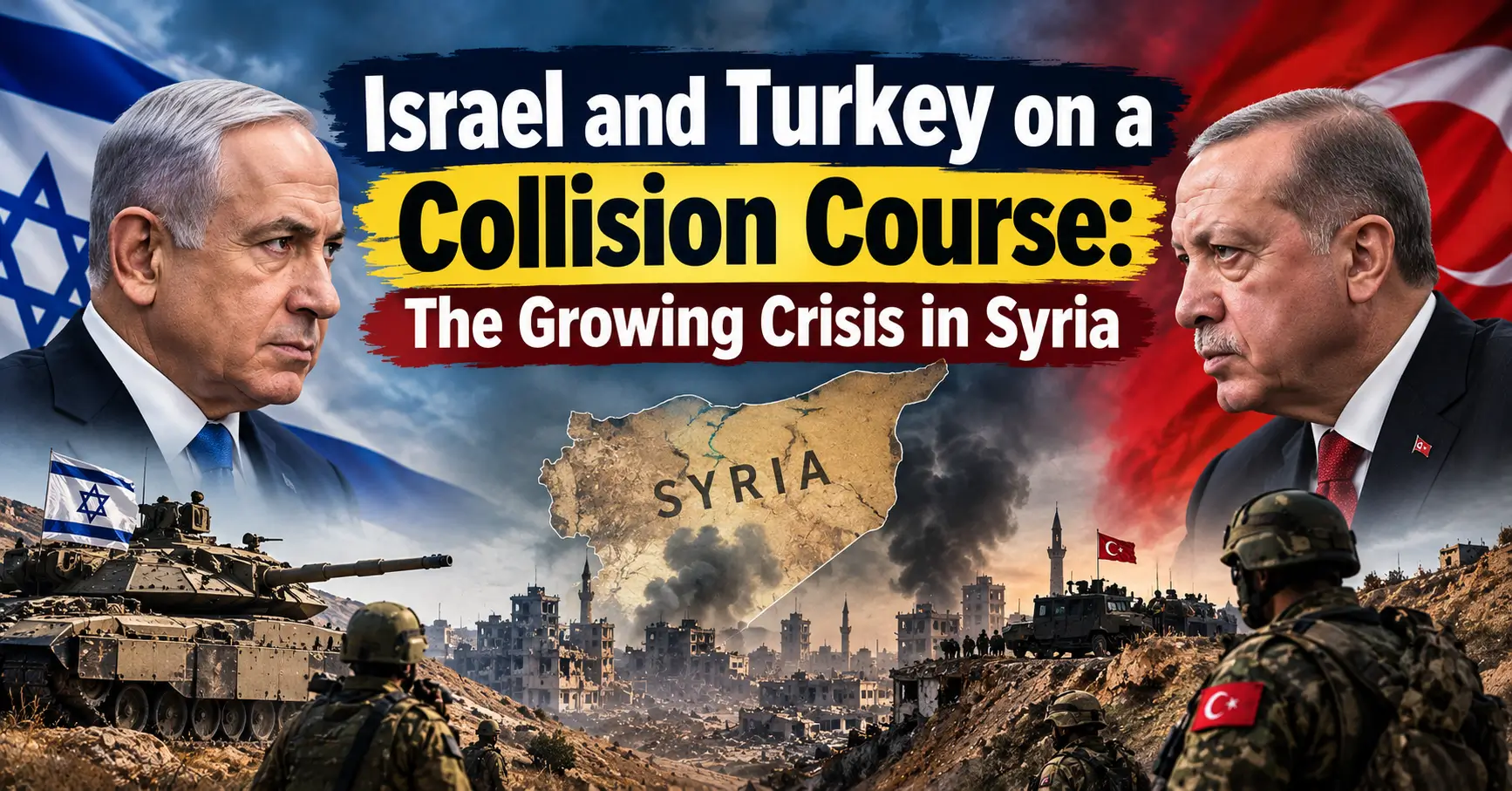
“Israel and Turkey on a Collision Course: The Growing Crisis in Syria”
“Israel and Turkey on a Collision Course The Trump administration should act quickly to resolve differences between its two most important allies in the Middle East.
It seems that a new and potentially very damaging inter-state crisis is brewing in theMiddle East, this time between Israel
and Turkey
. This was suggested as a possibility two years ago when Turkish President Recep Tayyip Erdoğan
said on October 2024, right before the rebel offensive that ended the presidency of Syrian President Bashar al-Assad, that “Israel’s next target will be Turkey.”
The Israeli bombing of Syria
’s Abu al-Duhur airbase that took place on August 18
, at first, looked like only a minor attack but might be viewed in the future as an initial indication of the fulfillment of the prediction. Moreover, that point in the history showed that the continued fall in the level of Israeli-Turkish relations reached an explicit stage of militarily. It was close to the Turkish border, and minutes earlier, the airbase was the location for an assessment by a Turkish military delegation
on the progress of the recovery efforts. As per the information released by Israel, the motive of the bombardment was a fear of a breach in the security arrangement whereby Israel is allowed a Turkish military base at that location. This statement by Israel was strongly refuted by Syria and Turkey.“Israel and Turkey on a Collision Course
Tom Barrack’s comments were even more stunning. Who was at that time the US ambassador to Turkey and also the Syria special envoy to Donald Trump
, made public
on behalf of the country that the Israeli strike did not happen in the presence of prior communication of its intention to the Turkish side. Consequently, it was a reasonable move to see Israeli aircraft entering the Turkish airspace before the border was a potential danger so Turkish fighters were dispatched in the air. However, what the Barrack statement implied was that probably Israel was using the Turks as a bait against getting involved in another military action.
Irrespective of how it turned out, the event was a clear pointer of how drastically the Middle East’s strategic landscape has changed. Formerly, the two countries, Turkey and Israel, belonged to the circle of an informal region-based alliance. The militaries of the two countries maintained close cooperation throughout
1990s, intelligence-sharing was done to a great extend, and also the two countries saw each other as effective balancing powers of the hostile neighbors. But President Erdoğan’s leadership caused the relationship between those two countries to deteriorate notably, especially after the 2010 Mavi Marmara incident
when the Israeli Navy killed twelve Turkish citizens. However, usually, these times were the beginning of a period when the two countries reconnected and tried to mend their differences. At one point in 2022, the governments in both countries even officially agreed upon
the resumption of their full diplomatic relations.“Israel and Turkey on a Collision Course
The point of a possible confrontation between Israeli and Turkish forces has been changed from Gaza to Syria, a field for which Turkey's strategic significance is much higher. In addition, the overthrow of dictator Bashar al-Assad and the emergence of government led by Ahmed al-Sharaa
have considerably raised Turkey's position in Syria.
Ankara became one of Damascus's foremost allies in political and military matters, providing Damascus with training and helping its armed forces and government agencies rebuild Syria's country. “Israel and Turkey on a Collision Course
But Israel has a very different opinion.
Its goal is to be able to move its Army wherever possible throughout Syria but to make sure that neither Syria nor its allies would be able to establish any means of restricting Israeli operations.
Therefore, these two countries have completely different outlooks when it comes to the future of Syria. “Israel and Turkey on a Collision Course
Turkey is in favor of reuniting Syrian and sovereign territorial state closely related to Ankara.
Different from Israel. “Israel and Turkey on a Collision Course
Israel's vision is a very decentralized and weak Syria, in such a way that strong military powers won't be able to take over the country and limit Israel's freedom of actions.
By this logic Israel’s military presence in the southern parts of Syria along with a series military attacks against the Syrian army facilities has only intensified Turkish belief that Israel is trying to keep the Syrian army weakened permanently and the country is divided at the same time.
In this context, the strike on Abu al-Duhur is particularly significant.
In a sense, the fact that Israel has not been trying to hit Iranian weapons shipment or Hezbollah position, things which have been historically used as Israel's rationale for carrying out military operations in the Syrian context.
This time Israel was targeting Turkish military infrastructure which had been reconstructed by Turkey.
The foreign minister of Syria has declared that Syria has already told Israel that the site won't be occupied by Turkey as a base forever.
In essence, Israel’s message is not limited to this particular issue alone. Israel seems to be sending a message that it will definitely not permit, a free-for-all Turkish armed force operating in Syria. Conveying it in the form of a threat to Turkey definitely can be a dangerous business.
While Iran is not a NATO
member, Turkey is. Moreover, Turkey’s Army ranks amongst the biggest and strongest forces of the Middle East.
Recently, through the Mecca Joint Defence Agreement
Ankara strengthened its strategic position vis-a-vis Saudi Arabia and Pakistan. It basically said that if any one of them suffered an armed invasion against them, it would be treated as if all three parties were attacked.
Premier Erdo?an
has recently shown his disapproval over Israel’s actions on an escalating scale only with words and not with military force.
However, it has been noticed that Turkey doesn’t really want war even though Erdo?an has been very outspoken in his response and Israel has also not been backing down.
Nevertheless, even slight tensions may lead to an unstable balance when both sides see their fundamental interests are being threatened. For example, it is very improbable that Turkey will allow Israel to prevent the military cooperation between Turkey and Syria to take place, especially since Syria’s stability is an essential issue for Ankara and also Turkey is very sensitive to a possible development by a Kurdish group on both sides of its Turkish-Syrian border.
That's the reason why Barrack’s warning deserves special attention. Washington is aiming at having a multilateral deconfliction plan where Israel, Turkey, and also Syria take part. Despite these efforts, little visible achievement seems to have been made. It is very true a mechanism of deconfliction is needed desperately but its immediate benefit only is in removing threat and there will be no resolution of the deep-rooted difference.
Essentially, the conflict is between Israel and Turkey on the one hand competing for the same picture of the post-Assad Middle East
At their worst, it was their alliance in Palestine which had served as their relationship base after the end of Palestinian Authority in 2005 that the two countries began drifting apart. After some time, their political rift became a strategic one. Israel was the culprit in the brazen interception of Global Sumud Flotilla that left some 175 persons arbitrarily detained. A year later on a day before the flotilla was to be set from Haifa harbor on its way toward Gaza in October 2025 Turkish authorities made their last attempt to secure an Interpol red notice for Netanyahu with a view to having the PM arrested by police forces anywhere. The whole episode just underlines the extent of the breakdown there has been in their relations.
After the strike on Abu al-Duhur the risk of confrontation having occurred right next was a little lower but at the same time the competition of bigger dimension became fiercer . Israel has declared openly that any Turkish military presence like a base or even an air defense system in Syria is their main objection and if need be would resort to force.
On the other hand, Azerbaijan
has been attempting to mediate
with Turkey and Israel. While diplomacy undoubtedly reduces the likelihood of an incidental clash, it will never tackle the fundamental issue: is that Turkey's military alliance with Syrian government after Bashar al-Assad's removal will be allowed without Israel's green-light?
At least for now, mutual restraint on each country and mediation by the US should help keep the two from becoming enemies. Unfortunately, the situation in general, is very gloomy. If Israeli leadership keeps regarding the rise of Turkey in Syria to military level a danger to them at the same a time that Turkey's view is shifting from one of competition of strategic interests to one of the desire to see all the military actions of Israel aimed at reshaping the Middle East, then it is quite possible that the two countries will cross from one step to the other where their military actions are aimed not even at strategic rivalry but direct confrontation. That way, a region which is already very dangerous will get even worse.
If such a scenario came to pass, the US would have been left with a very, very tough decision: either a close ally within NATO or a strategic partnership with a nation in the Middle East?
If things had escalated to the physical clash and Turkey had claimed its right as provided in Article 5 of the North Atlantic Treaty that a NATO ally should defend a country being attacked, the United States would have been obligated to defend the country that was the attack target. Since it is also part of their objective to preserve the stability of Syria under Post-Assad government a matter on which they also agree with Turkey Washington ought to use all forms of pressure available against Israel in order to promote the peace before the Israel-Turkey dispute goes further from where you couldn't easily retreat to either camp.
CSS Forum – Join Now