


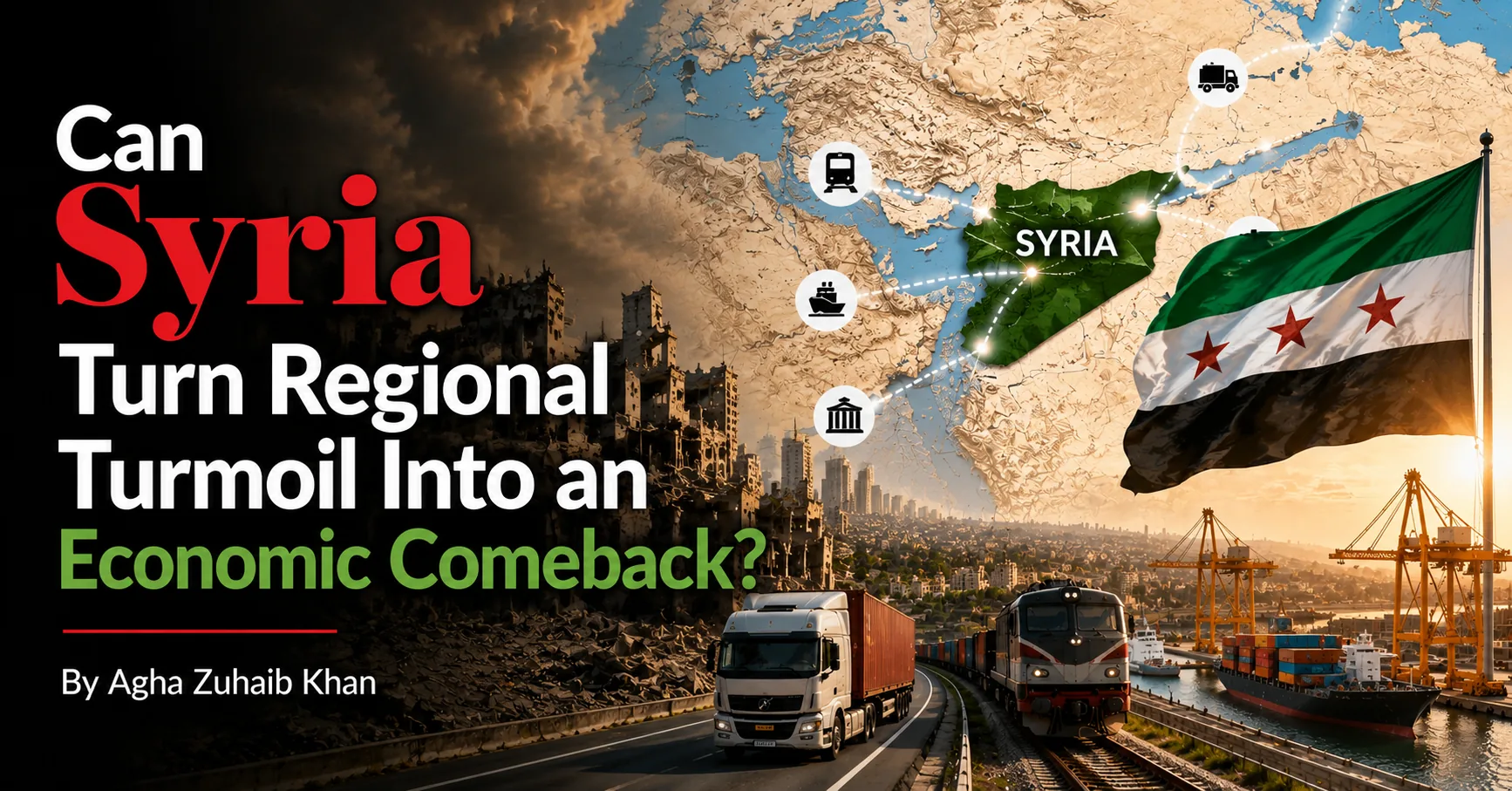
Can Syria Turn Regional Turmoil Into an Economic Comeback? By Agha Zuhaib Khan.
The Syrian civil war disrupted many of Syrian commercial activities including serving as a crucial link between Iraq, Jordan, Lebanon, Turkey, and the Mediterranean, as well as an important channel between Gulf states and European markets before 2011. Syria gradually resumed its role in regional trade after a military group called Hayat Tahrir al-Sham, previously the new leader of the group under the new president of Syria Ahmed al- Sharaa, led the overthrow of the Assad regime at the end of 2024. By August 2025, Syria’s customs authority estimated that around 327,000 trucks carrying over 7 million tons of goods had arrived from the outside.
Regional actors, Jordan, Qatar, Saudi Arabia, and Turkey restored their relationship with Syria and carried on business. At the same time, the new regime in Syria accelerated the rejoining of Syrian ties with a wide array of regional, European and other countries to break the economic isolation placed on Syria. However, even these actions are not yet sufficient to restore Syria, which had been a victim of a civil war for more than a decade, to its former status. The World Bank’s 2025 figures gave the Syrian reconstruction cost as $216 billion – almost tenfold Syria’s projected 2024 GDP.
Syria’s leaders are now trying to find a strategic advantage in the situation. Since the Iran war in February, investment opportunities in the country have multiplied. With the risk of Iran retaliation to United States, Israel, and other countries due to the dependence on the Strait of Hormuz and the alignment with the United States and Israel, the region is increasingly looking toward Syria's geography, especially its land and maritime routes. Syrian leadership hopes that the anticipated investment and trade boom will bring a new source of income as well as changing the country’s image from being the cause of migration, terrorism, and instability, to the transit center that facilitates regional connectivity. But the size and speed of investments may put stress on the institutions handling investments. Without proper inspection and transparent distribution, the investment rush currently appears so positive could actually undermine Syria’s recovery if the country is unable to effectively manage and absorb it.

The demand for a safer, diversified, and stronger transit system through the Middle East is nothing that can be said has come only recently, the civil war in Syria, however, made it impossible to go through the country for a period of 15 years. Discussions regarding the redevelopment of the Hejaz Railway line, which dates back to Ottoman Empire and was mostly demolished in WWI, were being held by Saudi Arabia and Turkey since 2009, but the plans were shelved after the outbreak of the Syrian war. Between 2010 and 2021, Syrian exports dropped by about 90 per cent. As the state was splintered, the major highways of the country were closed entirely. India, Saudi Arabia, UAE, and United States plus other European countries announced a Middle East-India-Europe Economic Corridor to help with intraregional and interregional ties and, at the same time, get Israel, the most notable partner in the corridor, closer to neighboring countries, as it became clear that Syria’s role in facilitating movement of goods was becoming redundant. Can Syria Turn Regional Turmoil Into an Economic Comeback? By Agha Zuhaib Khan
The blockade at the Strait of Hormuz is another reason why developing such corridors has become more urgent than ever. At mid-2023 and late 2023, Jordan, Saudi Arabia, Syria, and Turkey signed an agreement for the reconstruction of the Hejaz Railway in three to four years. Research carried out by the Atlantic Council and other regional rail corridors analysis point out to a capacity that the railway could initially transport of about 1.5 million containers in a year and that number could be doubled to 3 million as tracks and ports would be upgraded. This plan is in line with Shara’s ambitious idea to build the Four Seas and Nine Corridors, which he described at a casual EU summit in April with the attendance of leaders of Europe and the Middle East. Syria would be the central hub of that network connecting the Persian Gulf, Black Sea, Caspian Sea, and Mediterranean and enabling both the movement of goods on land and water, as well as the transportation of electricity and oil.
In July, the two countries also came to an agreement on the reconnection of the Kirkuk-Baniyas oil pipeline which was destroyed during the American invasion of Iraq in 2003 that was a permanent route of Iraqi crude oil to the Mediterranean. If it becomes fully operational as the estimated four-year timetable, it is expected to move two million barrels per day by 2030. That will account for approximately 60 percent of Iraq’s crude oil exports in the Iran war context and about 9 percent of all oil that passed through Strait of Hormuz. These combined projects with new routes through Turkey can enable Iraq to transfer more than 80 percent of its oil exports away from Hormuz, and, thus, end its near-complete reliance on Gulf terminals.
Still, none of these is a sure sign of better economic or political life for Syrians. Given that the location of Syria is very important strategically, Damascus would certainly be a favorite location for foreign governments looking to establish alternative exporting routes, but this same geographical situation will also put Syria in the crossroads of different countries and countries groups. The close security alliance of Saudi Arabia and Turkey, the UAE gradually shifting into a commercial role at ports and logistics sector, and Israel trying to stop Turkey’s influence in its surrounding areas, all are the examples of how different interests of countries with Syria being a central or a key element will lead to disputes. Who pays, who runs, and what is the level of security for each of these corridors will be the main issues, and Syria could be pulled into those rivalries that its fragile state is hardly able to cope with. Can Syria Turn Regional Turmoil Into an Economic Comeback? By Agha Zuhaib Khan.
Syria is at risk of being dragged into trade rivalries that it cannot withstand given the instability it still faces. Damascus, trying to reduce that risk, has worked with almost all powers who are willing to help Syria's recovery and reintegration including Qatar, Saudi Arabia, Turkey, the UAE, the US, besides China and Russia. The maintaining of such a delicate situation is, however, becoming more difficult through time. Syria, with its dependence on its biggest financial sponsors, is now gravitating more towards Qatari-Saudi-Turkish alliance. If these countries compete over their routes and Syria is not fast enough to control them, the only outcome will be larger foreign interference and looting.
Israel can be a major barrier to Syria's comeback as a trustworthy regional trade passage. If the reconstruction of the Hejaz Railway turns out well, Israel's role in supporting the India–Middle East–Europe Economic Corridor, and its role as a Mediterranean gateway for Arab countries, will get smaller. Israel might even try to keep that from being so. In February, Israeli Prime Minister Benjamin Netanyahu expressed that there has been “an emerging radical Sunni axis” with Syria's strengthening ties to Qatar, Saudi Arabia, and Turkey. In June, Israeli Transport Minister Miri Regev viewed international trade and energy alliances aimed at doing away with Israel as “a very serious threat to national security,” therefore placing Syria’s coming as an alternative route under Israel’s security-related concerns as a whole. Moreover, Israel has proven to be willing to use its military against its enemies. In 2025, it bombed a Hamas compound in Doha, launched intensive raids over Syria—which included attacks on air bases where Turkish troops were planning to station—and gained more territory in southern Syria. In August 2026, according to the statement of Israeli Defense Minister Israel Katz, Damascus was supposedly preparing to allow a Turkish troop deployment at the Abu al-Duhur airbase, and therefore the base was bombed by Israel.
Damascus is not willing to go to war with Israel, consequently, it is not taking any military action to retaliate but is negotiating through the US. Nonetheless, this cautious policy may prevent Israel from carrying out various acts – the extending of its illegal occupation of Syrian land, hitting Syrian infrastructure, and causing instability via the encouragement of relationships with the minorities of Syria. All these actions are hindering recovery projects in Syria. As Middle East commentators Shira Efron and Danny Citrinowicz point out in the Foreign Affairs magazine, the steps of the new government of Syria to prevent such attacks could result in a long-standing hostile relationship between Syria and Israel, and they would also need even more aid from other countries.
Foreign powers increasingly getting deeply in Syria are also influencing key political dimensions of reconstruction. For years, Assad has been giving access rights of Syrian territory and economies to the Governments supporting his repressive regime as a gift to them during the civil war. For instance, Russia put down military bases and made money with mineral, oil and gas concessions plus secured harbours. Iran converted Syria into a land corridor for supplies to Lebanon and even stationed large number of troops in Syria. Efforts to recreate the Syrian government after removing Assad were all done underneath this history. Shara's government has practically abandoned the idea of outsourcing the sovereignty of Syria. It has kicked the Iranian troops and Hezbollah, broken the networks which were helping Iran's military corridor across Syria, and gained the control over the Russian-run naval facilities. The latter will run such facilities in collaboration with the Syrian authorities though. However, this does not mean that the threat of sovereignty transfer is over. For now, the government is unable to reunify the whole country and still has some sort of divided internal administrative structure. Customs administrations throughout Syria had, for instance, been held by different and hostile national and non-state organizations, primarily the Kurdish Autonomous Administration North East Syria, the leader-based one. Although customs authorities of the areas previously under Kurdish control have largely returned to Damascus, a principal crossing between them and Turkey is still closed. Can Syria Turn Regional Turmoil Into an Economic Comeback? By Agha Zuhaib Khan.
Searching for the required fund for reconstruction, Syriana new government has lowered the rules in front of investors and partners who would like to develop the country’s routes, ports, and area – investments which could potentially re-integrate the separate parts of the country as well. In early June, Shara put down a regulation allowing foreign investors to fully control all but a few sectors, profit repatriation without any restrictions, and significant tax and customs privileges besides that. Nevertheless, the decree keeps all matters of investment permits, getting state lands or being selected for main tax privileges at the discretion of institutions whose loyalty has to be guaranteed to the president so they could be the ones to decide who gets access to Syria’s economic recovery. Such concentration might help speed up and streamline decision-makinng. Nevertheless, as without proper, independent, oversight and since Syria has not yet implemented such mechanisms – which is an issue here – it may also bring back the practice of the former regime – giving economic privileges as political favors. Rebuilding of physical structures, therefore, could very well continue being another tool to distribute power by political patronage – thus, it becomes another method of keeping people at bay – so the government will lose the support of those it doesn't favor, in other words, the ones not part of political patronage. At the same time, it will rekindle the inequalities that led to the country’s division in the first place.
Also, the long-term concessions enable the foreign entities to exercise considerable power over the essential infrastructure. Under a contract that allows the Syrian government to get 60 percent of the revenue of the main Syrian port that is currently in the possession of the French-owned shipping company CMA CGM, that French shipping company has signed a long-term concession agreement of 30 years. On the other side, through an operational control agreement for Syria’s second-largest port that has a 30-year period of duration, DP World, a logistics company based in the UAE, will finance and build the new port facilities and receive the operating rights as a reward, with control passing back to Damascus after thirty years. Since the details of the revenue-sharing arrangement are not made public, it is still unknown how much will come to the state budget of Syria or how those funds are going to be spent and who can get those.
This scenario will not result in genuine benefits for transport linkages and foreign direct investments if Damascus and other parts of Syria continue living apart due to the persistent divisions even after the government and opposition groups have laid down arms. The fate of Syrian foreign investment in a sense is the fate of local benefits to communities. The government's success so far is very clear to all eyes, but the task ahead is far from being easy. A major part of Shara's endeavor has been to get Syria back together over the past two years through large-scale use of force. Distrust has grown between the government and the Alawite-majority coastal region, where conflict has been particularly strong, as well as between the government and Druze-majority Suwayda region and between the government and Kurdish-led areas of the northeast of Syria in the whole period. Can Syria Turn Regional Turmoil Into an Economic Comeback? By Agha Zuhaib Khan.
The fact that Damascus and the Syrian Democratic Forces (SDF) a U.S. backed and Kurdish-led coalition who used to take most northeastern areas of Syria out of control by the Islamic State or ISIS, were in confrontation with each other again was the clearest warning of a resumption of civil warfare. Damascus and SDF leaders agreed to a merger in March 2025, but a disagreement at first over military integration and Kurdish autonomy stopped it from happening. Eventually, there was shooting and over half million people have been displaced. Through a cease-fire negotiation organized by U.S. the advancing northward move of the government was stopped and then the leaders of Damascus and SDF made a deal to get the control of cross-border points, oil and gas resources and municipal bodies transferred to Damascus in addition to the integration of SDF members into Syrian army. A few months later, SDF general Mazloum Abdi publicly said, in an interview, that the union of the SDF had been finished and the plan of having a separate political administration in the area where Kurds are in majority has been terminated. What is happening in reality is, that a lot of things which were under control of Kurdish authorities have now begun to be handed over to Damascus through the gradual implementation of this agreement.
We might say on a paper basis, the January deal between Damascus and the SDF serves as a way of settling informal wartime boundaries, reopening the closed routes, and harmonizing competing tasks and parallel governance systems. If, however, the majority of Kurds in the northeast think that putting Syria back together would not protect them very well or that it would not be adequate to meet them up with Kurdish rights and representation, they will probably take the path of resistance, thereby making it even more difficult for Damascus to exercise their complete control over Syria and its transit corridors.
A political pressure factor, besides everything, is that Syrians who are going back to their home country will bring new challenges. An approximate figure of 3,590,000 refugees have come back, while an equal number of internally displaced people are estimated to have settled back in Syria. A lot of these, for instance, have been coming from countries where they have had to stay for a very long time because they fled their homes as a result of war. Many others are returning to places that their governments are not even able to supply them with their basic needs let alone build better houses for all of them or provide everyone with decent livelihoods. Their influx has brought about the need for more houses, and thus more jobs, and services will be competing for the scarce ones. There will be new grievances and probably clashes if the movement of returning is on the increase. That would make it quite hard to get these people to the point where they start to be considered as one of the people whose lives have been touched by the success of the government unless Damascus provides sufficient resources and autonomy to local governorates and municipalities in the matter of problems relating to publicservices, jobs and education as they happen.
Only when an effort is made by the state to distribute revenues from foreign concessions or projects among local communities through investment in economic activities at local level will Syria be successful in avoiding a resumption of the previous system of economy characterized by dependency on transit fees and foreign concessions which is rentier by nature.
Syria regaining favor as a strategic transit point for regional trade has, for Damascus, resulted in getting three important things that the country is desperately in need of: revenue, relevance, and leverage. Can Syria Turn Regional Turmoil Into an Economic Comeback? By Agha Zuhaib Khan. However, none of these things are guaranteed to be permanent. The Syrian government must now capitalize on Syria’s revived status as a trade hub by creating functional institutions, providing resources for reconstruction across the board, and making progress in the resolution of longstanding divisions. If it fails, Syria could once again find itself on the regional map, but only as a precarious route serving the commercial interests of others. Can Syria Turn Regional Turmoil Into an Economic Comeback? By Agha Zuhaib Khan.
CSS Forum – Join Now
