


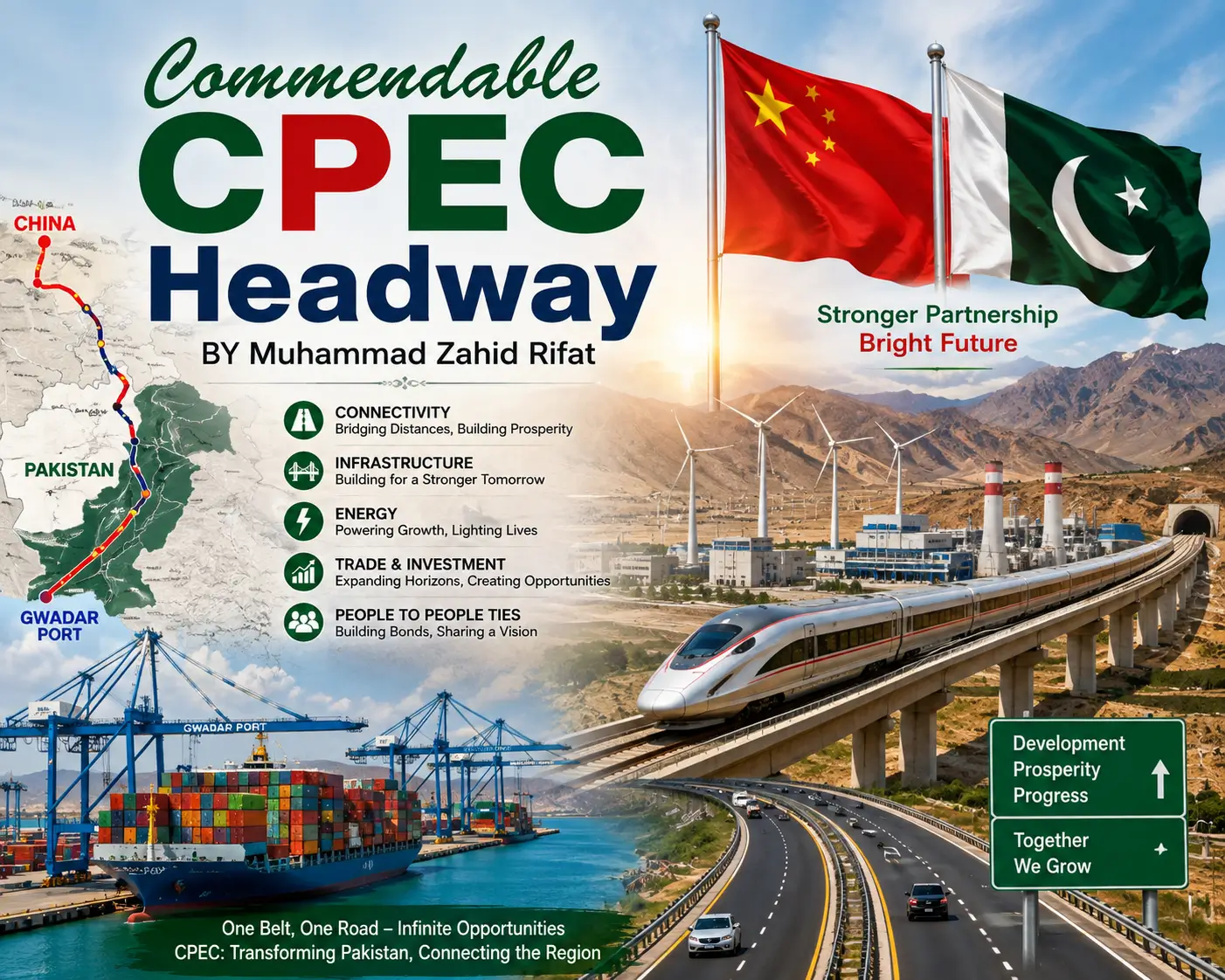
The China-Pakistan Economic Corridor (CPEC) was conceived in July 2013 during Prime Minister Nawaz Sharif's visit to China and formally launched during Chinese President Xi Jinping's historic visit to Pakistan in April 2015. The initiative began with the signing of 52 agreements and Memorandums of Understanding worth US$46 billion.
CPEC is a long-term strategic programme designed to promote industrialisation, trade facilitation, regional connectivity, integration into global value chains and socio-economic development. Its scope also includes poverty alleviation, agricultural modernisation, the operationalisation of Gwadar Port and promotion of the blue economy. Over time, cooperation has expanded into science and information technology, while remaining open to third-party participation.
Chamtar Dumping Ground suffers from poor planning, neglect in Mardan
As CPEC moves into its second phase, emphasis is shifting towards inclusive socio-economic development and the Sustainable Development Goals. Pakistan and China have reiterated their commitment to five priority corridors: Growth, Innovation, Green Development, Livelihood Improvement and Regional Openness. These also broadly align with Pakistan's National Economic Transformation Plan, URAAN Pakistan.
Over the past decade, CPEC has evolved from a connectivity initiative into a wider development framework. Under its first phase, 15 of 17 approved projects have reportedly been completed, with the remaining two at advanced stages. Seven additional initiatives have also been proposed to the China International Development Cooperation Agency. These include agricultural machinery, fibreglass fishing boats for coastal communities, a fish-landing jetty at Gwadar, integrated cold-chain systems and other livelihood-oriented projects intended to improve productivity, food security, employment and exports.
KP Governor calls for market-oriented skills, jobs for fresh graduates
During 2025-26, the proposed upgrading of the 1,872-kilometre Main Line-1 railway from Karachi to Peshawar remained a major strategic priority. Discussions advanced on third-party financing by the Asian Development Bank and Asian Infrastructure Investment Bank for the Karachi-Rohri section, while financing and implementation proposals for the remaining sections were developed with the Chinese side. Once completed, ML-1 is expected to raise passenger train speeds, improve freight capacity, reduce transit times and strengthen north-south connectivity.
Progress was also made on the Karakoram Highway Phase-II Realignment Project, necessitated by construction of the Dasu Dam. Pakistan and China operationalised a phased implementation strategy and reached broad consensus on an 85:15 financing arrangement.
MoU signed to provide 80pc tuition fees to deserving Shangla students
Gwadar continued to remain central to CPEC's infrastructure ambitions. The 19-kilometre, six-lane East Bay Expressway has improved connectivity between Gwadar Port and the Makran Coastal Highway, while further work has focused on linking the port with the New Gwadar International Airport. Gwadar Port and its Free Zones have also moved towards greater operational maturity through improved infrastructure, utilities and investor facilitation, with emphasis on export-oriented manufacturing, warehousing, fisheries processing and logistics.
Industrial cooperation also advanced through CPEC's Special Economic Zones. Phase-I of Rashakai SEZ has been operationalised, while development continued at Allama Iqbal Industrial City, Bostan SEZ and Dhabeji SEZ. Industrial plots have been allotted to investors and work on electricity, gas and water infrastructure is progressing.
Meeting approves KP’s first-ever Child Protection Policy
Pakistan-China cooperation in information technology has similarly deepened. Two MoUs signed in September 2025 covered the establishment of the China-SCO (Pakistan) Artificial Intelligence Application Cooperation Centre and enhanced bilateral AI cooperation. An ICT Cooperation Action Plan for 2026-30 was also finalised, alongside work on digital infrastructure, cybersecurity, 5G readiness and digital skills.
Science and technology cooperation has also expanded. Joint laboratories, research projects and scientific exchanges are now covering fields including climate change, agriculture, health, artificial intelligence and earth sciences. STEM laboratories have been established, teachers trained and hundreds of Pakistani scientists facilitated for engagements in China. A joint marine research cruise has also been completed.
IPRI holds Strategic Communications Workshop 2026
In the energy sector, efforts have focused on improving efficiency, grid stability and electricity provision for Special Economic Zones. Continued use of indigenous Thar coal has helped reduce dependence on imported fuels, conserve foreign exchange and support baseload electricity generation.
With the first phase substantially completed, attention is now turning towards CPEC Phase-II. High-level engagement between President Xi Jinping and Prime Minister Muhammad Shehbaz Sharif continues as both sides work towards formally advancing the next stage during 2026.
CPEC has already travelled a considerable distance from its original conception. Its future success, however, will depend not simply on announcements but on timely implementation, stronger industrial cooperation, greater technological integration and tangible benefits for ordinary Pakistanis. If the momentum of the past decade is sustained, CPEC can continue to play a major role in Pakistan's economic transformation.
SOURCE:https://www.nation.com.pk/26-Aug-2026/commendable-cpec-headway
CSS Forum – Join Now