

A Complete Resource for CSS Islamic History and Culture Preparation
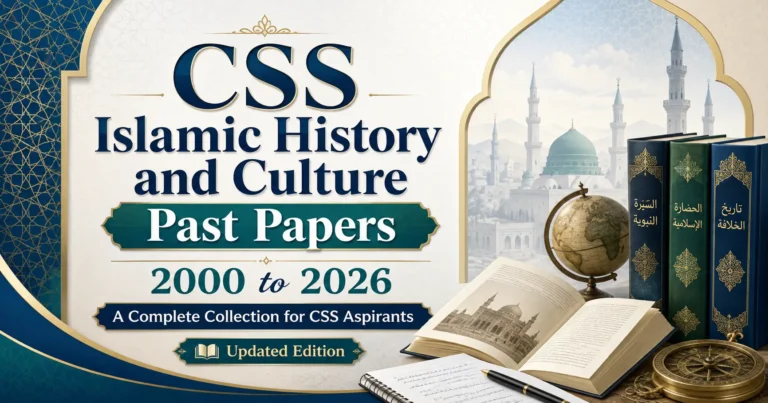
CSS Islamic History and Culture Past Papers 2000 to 2026 provide CSS aspirants with a comprehensive collection of previous examination papers for this important optional subject. Firstly, these papers help candidates understand the nature of questions asked by the Federal Public Service Commission. Moreover, they reveal recurring themes, important historical periods, and frequently tested personalities.
Secondly, students can use these past papers to evaluate the changing examination trends. Therefore, regular practice helps candidates improve their analytical approach and answer-writing skills. Furthermore, the collection covers more than two decades of CSS examinations, making it highly useful for both beginners and experienced aspirants.
-
Islamic History & Culture 2001 – 2005
-
Islamic History & Culture 2006
-
Islamic History & Culture 2007
-
Islamic History & Culture 2008
-
Islamic History & Culture 2009
-
Islamic History & Culture 2010
-
Islamic History & Culture 2011
-
Islamic History & Culture 2012
-
Islamic History & Culture 2013
-
Islamic History & Culture 2014
-
Islamic History & Culture 2015
-
Islamic History & Culture 2016
-
Islamic History & Culture 2017
-
Islamic History & Culture 2018
-
Islamic History & Culture 2019
-
Islamic History & Culture 2020
-
Islamic History & Culture 2021
-
Islamic History & Culture 2022
-
Islamic History & Culture 2023
-
Islamic History & Culture 2024
-
Islamic History & Culture 2025
-
Islamic History & Culture 2026
Important Features of This Book
- Complete CSS Islamic History and Culture past papers from 2000 to 2026
- Covers important questions from Paper I and Paper II
- Helps identify frequently repeated topics
- Useful for understanding FPSC question patterns
- Supports effective topic-wise revision
- Improves answer-writing and time-management skills
- Helps candidates prepare a focused CSS study strategy
- Suitable for both self-study and classroom preparation
Why Past Papers Matter for CSS Preparation
Additionally, past papers allow students to connect the syllabus with actual examination questions. For example, aspirants can identify questions related to the rise of Islam, the Khulafa-e-Rashideen, Muslim political institutions, scientific achievements, Muslim Spain, and major Islamic dynasties. Similarly, candidates can study how FPSC frames questions about Muslim intellectual, cultural, and administrative developments.
Consequently, students can prioritize important areas instead of studying every topic with equal intensity. However, aspirants should not rely only on repeated questions. Instead, they should use past papers alongside standard books, updated notes, and the official syllabus.
Improve Your Answer-Writing Strategy
Meanwhile, solving questions under timed conditions develops examination discipline. In addition, students learn how to organize introductions, arguments, historical evidence, and conclusions. Likewise, reviewing several years together makes important trends easier to recognize.
Hence, candidates can create topic-wise lists of repeated questions. Afterward, they can prepare structured answers for major themes. Nevertheless, each answer should show analysis rather than simple narration. Thus, candidates should include relevant dates, historical developments, scholarly opinions, and critical evaluation.
Ultimately, CSS Islamic History and Culture Past Papers 2000 to 2026 serves as a practical preparation resource. Besides, it saves valuable research time. As a result, aspirants can focus on important topics, strengthen revision, and approach the examination with greater confidence. Finally, consistent practice with these papers can significantly improve preparation quality and examination performance.
CSS Forum – Join Now