


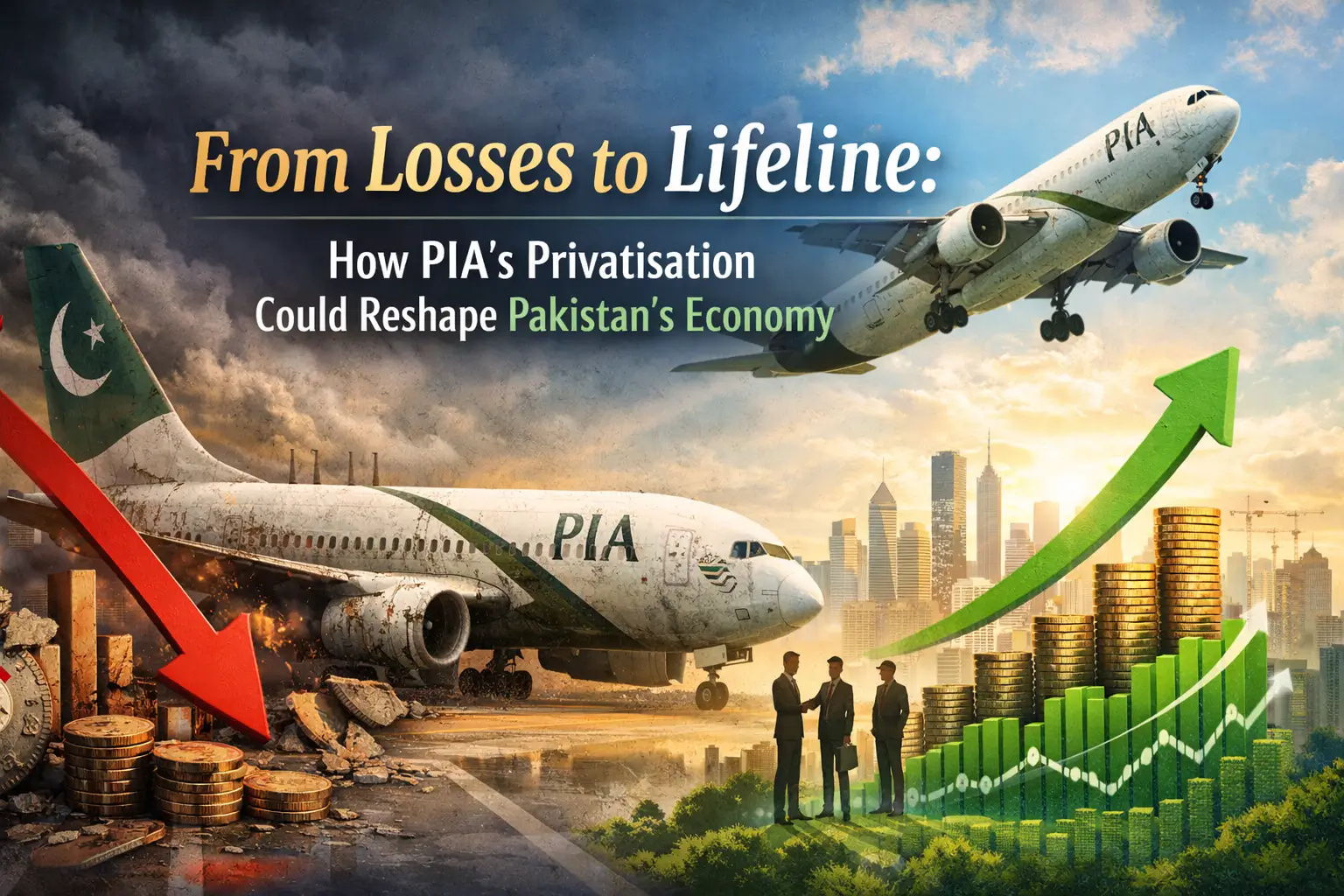
On Tuesday, the federal government finalized the sale of its 75% shareholding in Pakistan International Airlines (PIA), thus marking the end of years of delay and by losing the national carrier. The shares were sold to a group led by the well-known businessman Arif Habib for Rs10.1 billion in cash, that is Pakistan's first big privatisation deal in almost two decades.
During the 13th round of open bidding, the winning consortium—Arif Habib, Fawad Ahmed Mukhtar, Gohar Ejaz and Aqeel Karim Dhedhi—bid the highest amount of Rs135 billion. Their offer was higher than the one from the consortium led by Muhammad Ali Tabba who left after the tough bidding.
There was also a group Air Blue that was dismissed early on after submitting an offer of Rs26.5 billion, which was way below the government's reserve price of Rs100 billion. Interestingly, this reserve price was lower than the unsuccessful privatisation attempt when authorities asked for Rs85 billion for a smaller 60% stake although PIA had negative equity at that time.
Muhammad Ali, the Prime Minister's Advisor on Privatisation, said that of the Rs135 billion bid only Rs10 billion ($36 million) would go directly to the government, and the rest of the money would be PIA's capital investment. This deal signifies another attempt at PIA privatisation over a year, and the first successful sale of a big public sector enterprise after the disposal of K-Electric in 2005.
Prime Minister Shehbaz Sharif had wanted to get as high as Rs200 billion for PIA but the cabinet decided to sell the company as they were worried about PIA's growing losses. The government cleaned up the airline's books by taking out Rs670 billion worth of liabilities—a move that means the taxpayers will have to foot the bill. Just for this year, debt servicing will be around Rs35 billion and the same level of payments will go on for at least six more years.
During the auction, Arif Habib Group significantly changed its approach going aggressively in the bidding situation, while their opponent consortium was cautious with their bids, only raised the offers by Rs 250 million in each of the first eight rounds. The competitors took a short break for consultation after which they gave up when the price went up to Rs135 billion.
In this second privatisation attempt, several enticing offers were made by the government to give the deal a push. Among them were sales tax exemption on aircraft leasing of 18%, tax credits amounting to Rs36 billion, and the option to extend over Rs33 billion outstanding dues payment to the Federal Board of Revenue (FBR) and the Civil Aviation Authority (CAA).
Together the two bidders placed a total value of Rs180 billion ($640 million) on PIA for 100% ownership. The winning party has to make the deposit of two-thirds of the total bid amount within three months of the announcement, and can pay the remaining one-third within a year. However, the government, in the meantime, will hold one-third of the shares.
The successful bidder has the right to declare within three months if they want to buy the remaining 25% shares at a price that is 12% higher than auction price. The group can also bring in two new partners, one of whom could be an international airline. According to officials, Fauji Fertilizer may be the fifth partner.
The government envisions that PIA within a four-year period would operate 40 aircraft that will be in perfect working condition and raise the yearly passenger traffic from 4 million to 7 million. In a talk with the labor force, Arif Habib gave the assurance that not only the qualified staff would be kept but also their remuneration would be increased. The current workforce will not be subjected to any layoffs for at least a year, and employee medical obligations have been transferred to a holding company with state funding.
Habib disclosed the idea of outfitting the airline with 18 new aircraft, with an ultimate goal of having 64 planes in the fleet based on market demand. At the moment PIA is only able to run a fleet of 18 planes out of a total of 34.
In the course of the auction, Arif Habib Group took a very aggressive approach by contrast a rival consortium went quite cautiously, upping their offers by only Rs250 million in each of the first eight rounds. After a short break for consulting the opposing bidders yielded after the price touched Rs135 billion.
In order to maximise the likelihood of success of the government's second privatisation move, the scheme beyond just providing an array of inducements went as far as lifting the sales tax by 18% exemption on the leasing of aircraft, providing tax credits worth Rs36 billion and allowing for the settlement of over Rs33 billion in disputed dues to the board of the Federal Board of Revenue (FBR) and the Civil Aviation Authority (CAA) at a later date.
The offerors put the worth of PIA on the shareholder side at Rs180 billion ($640 million) in the agreement for a complete 100% ownership of the airline. The winning bidder is obligated to get down to the short work of depositing the first two-thirds of the bid price within three months, while the last third be settled up one year after the initial balloon payment. The underlying sovereign will still keep one-third shareholding until the completion of the full payment process.
The successful bidder will be given a three months period to consider if they want to buy the remaining 25% share at 12% more than the auction cost. What is more, the consortium may bring in two more members with them, and thus, possibly include an international airline amongst the partners. According to the latest reports, Fauji Fertilizer could be the fifth partner coming on board.
Separately, the Economic Coordination Committee (ECC) has given the green light on Rs2 billion (is more than $7 million) to cover the tax liabilities and loan instalments of the Roosevelt Hotel in New York City, which is a PIA-owned property.
According to the authorities, this magnitude of PIA privatisation result may eventually open the door for the sale of other government-run enterprises and also be instrumental in the revival of investors’ confidence amidst the tough business environment in Pakistan. The national carrier currently has a workforce comprising of 6,900 permanent employees and 2,900 contractual workers, plus holding some highly sought after slot times at the world's major airports such as London Heathrow.
In his congratulatory note, Prime Minister Shehbaz Sharif was quoted saying no matter which consortium kerfuffled the win, the country ultimately stood to gain the most out of the deal. Besides that, he also pointed out that the very strong presence of the major business groups was a clear indicator of their regained trust in the country's economic outlook.
CSS Forum – Join Now
