


Government Priorities and Public Concerns
New Provinces: A Solution There is a very clear divide in the way government officials and the public view issues affecting the country's socio-economic development. People are increasingly worried about the high prices of basic commodities, instability of the economy, as well as their uncertain financial future, whereas the government's attention is drawn to restructuring provinces in the country. The recent Ipsos survey results indicate that the majority of people are of the opinion that Pakistan is regressing. The economy and particularly the price hikes are the chief matters of concern to the citizens.
This pessimistic outlook among ordinary citizens should be a strong message for the policymakers that their attention should be first on things like economic relief, job creation, better governance, and other essential public services rather than focusing on controversial administrative changes. The government has not yet come up with a satisfactory or convincing argument about the creation of more provinces nor has there been any sort of thorough assessment of the political, economic, and administrative effects of such a change.
The Debate Over New Provinces
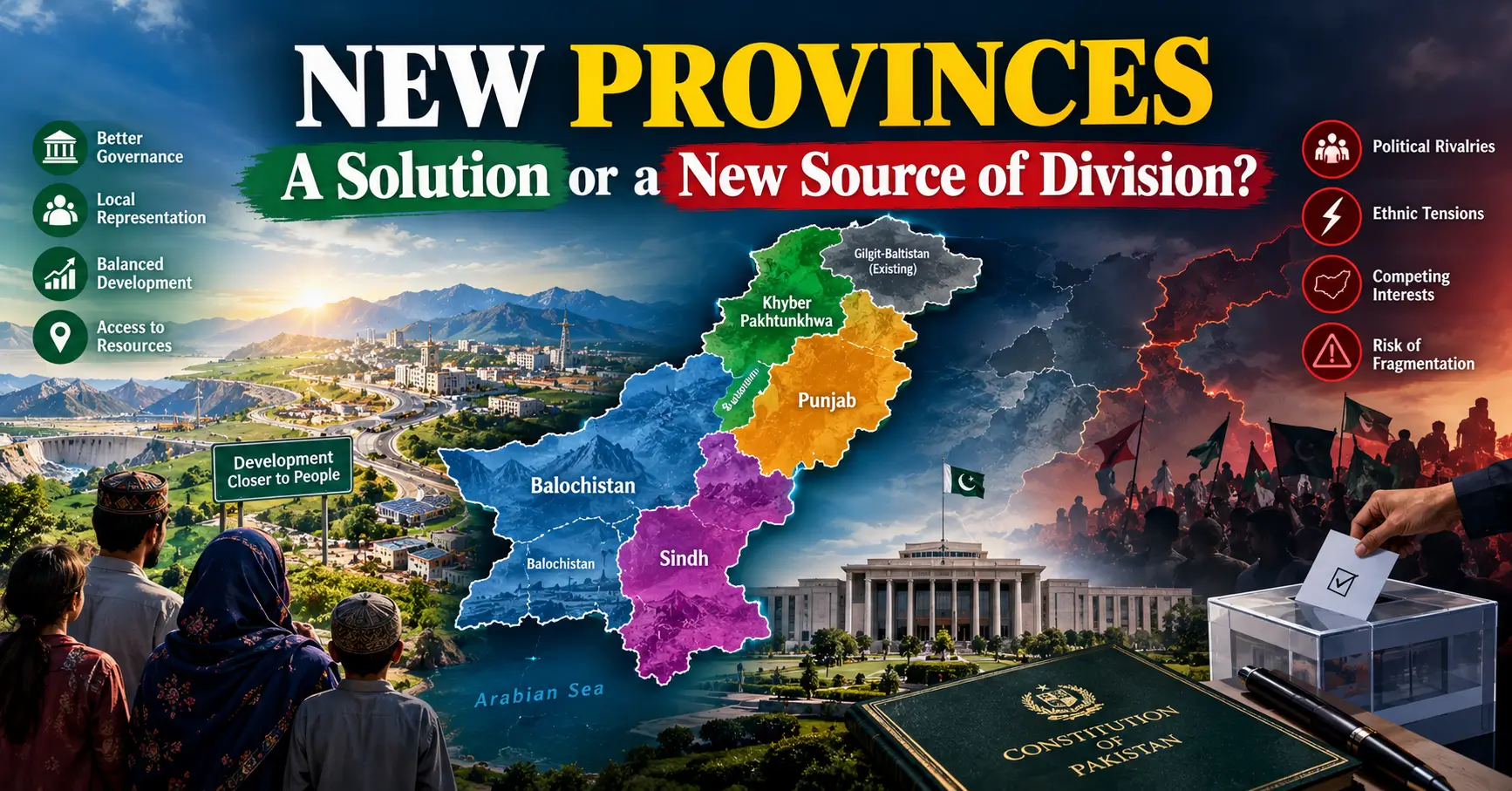
The discussion about increasing the number of administrative regions in Pakistan has once again taken centre-stage in political discourse with the federal government pushing it. Interior Minister Mohsin Naqvi declared in support of new provinces, at the same time Planning Minister Ahsan lQbali went so far as suggesting that there may be 15 provinces or at the very least a more robust form of districts. Backers claim that by breaking up government offices into smaller pieces, we achieve better governance on the one hand and get closer to the people by delivering services on the other.
Nevertheless, this new idea has been challenged politically and has received sharp opposition. The PPP has stated it categorically that they are against the splitting of Sindh. The other political parties, for the most part, have not given much indication of where they stand except a few have expressed a somewhat negative attitude which is, in some sense, similar to the PPP. They have also questioned the timing of the proposal as well as the possible political motivation for the move. The uncertainty has also been worsened by the fact that the members of the government seem to be at odds with each other.
Political and Constitutional Challenges
The introduction of any new province is not so simple, it would require, in the first place, the agreement of all the stakeholders in the country. The Constitution is very specific in this regard of how a province is added or boundaries are changed.
In the first step, the change needs to be given the nod the assembly of the province involved with a two-thirds majority. Once the province approves the change, Parliament must be in agreement on the amendments to the Constitution required as a result of the change with two-thirds majority in both upper and lower Houses.
There is no way a plebiscite would be allowed to go against the procedure provided the Constitution. The authorities who try to get around the requirements will end up in legal tussles and lose the trust of the public.
Strengthening Local Government
Governance Requires More Than New Provinces
Pakistan is undoubtedly a country that needs to have its system of governance reformed in order to improve the delivery of services and to get things running efficiently on a daily basis. Nevertheless, drawing provincial boundaries to suit certain politicians' personal preferences or the interests of various parties cannot be the only answer to all the governance problems. One of the best ways to bring change is through making local governments powerful and functional in decision-making and services delivery, which would have an impact at the grassroots. To do their job well, local authorities will need to have more powers, better financial support, and trained staff. New Provinces: A Solution
Important Features:
- Major complaints from the public center the economy and prices
- Administrative changes have been suggested as the way forward.
- Broadly speaking, the public is not unanimous on this issue.
- As a first measure, a constitution must be followed any time a provincial area is redefined.
- Well-functioning local-level governments are instrumental in providing better service to the people.
- Having the leadership accountable and possessing the required capacity will result in better governance.
- Structuring the system of government anew is no substitute for getting rid of the underlying problems with the economy and institutions.
The Need for National Consensus
Prior to undertaking structural reforms that are likely to be divisive, the government should focus on responding to people's concerns which they have been raising quite a lot and also on delivering the promises the government made at the time when the elections were being held. Any alteration of the provincial system is going to demand, above anything else, the agreement of all sections of the people and it is constitutionally also only after the citizens express their approval that such changes become valid. New Provinces: A Solution
The people of Pakistan desire changes that will rebuild the country’s institutions from bottom to top, get their trust back, and create better economic and physical living conditions. In addition to these, they demand transparency in government processes, more democratic participation, and better quality of life. It is worth noting that while making new districts or provinces is an administrative solution, they will still not substitute for the lack of proper leadership and responsible governance at different levels of government, which is a much bigger issue. New Provinces: A Solution
CSS Forum – Join Now