


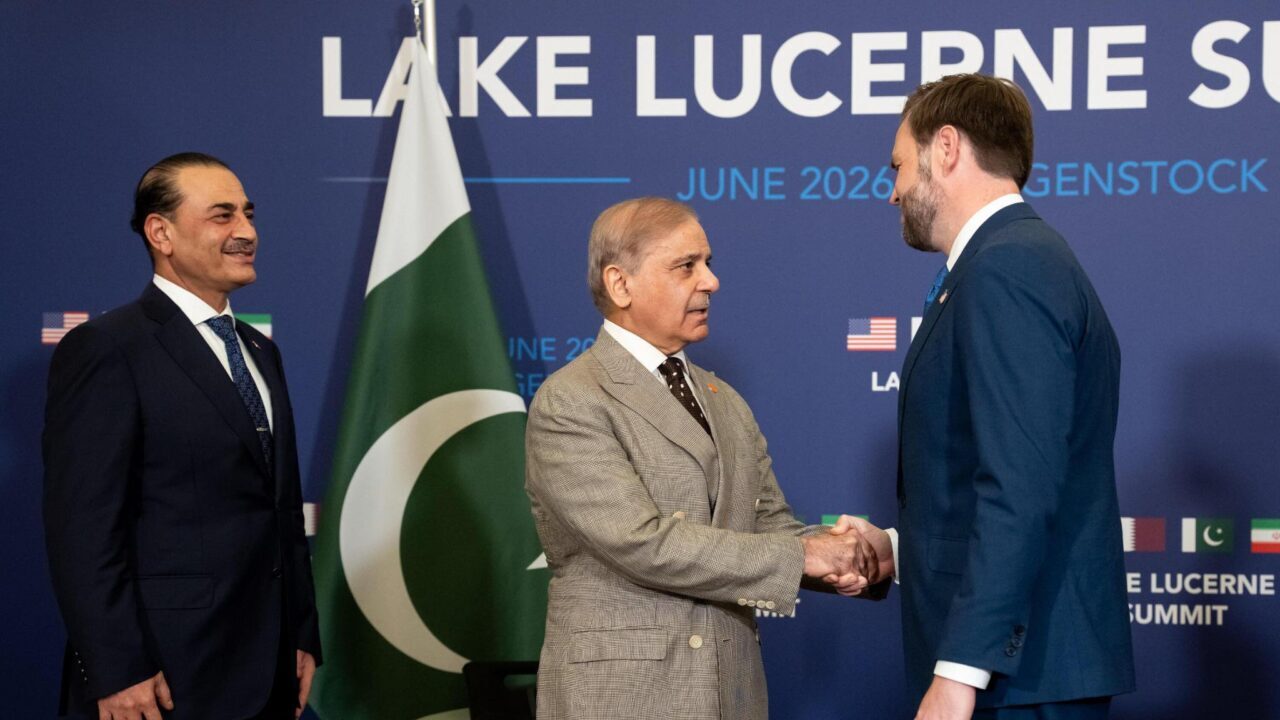
The arc of the US-Pakistan relationship invariably bends toward the perpetuation of military rule in Islamabad.
When it comes to US-Pakistan relations, history is playing on repeat.
President Donald Trump is the latest American president to develop a fondness for yet another Pakistani military ruler promising big wins—from critical minerals and crypto deals to counterterrorism and, more recently, mediation with Iran. Pakistan recently sought to cash in on this relationship quite literally, requesting a $10 billion currency-exchange stabilization fund.
But if one thing is predictable in US-Pakistan relations over the last 70 years, it is that big promises often turn into big disappointments and even bigger blame games. Field Marshal Asim Munir’s role in the Iran peace process risks becoming another disappointment.
While Pakistan helped broker an interim agreement between Washington and Tehran, it seems to be unraveling quickly. For Munir, however, the true prize is not the deal but the continued endorsement of President Trump. It confers international legitimacy as his military rule faces deep questions at home, amid former Prime Minister Imran Khan’s continued imprisonment.
Once again, Washington seems captivated by the idea of a Pakistani general who can promise to deliver when others cannot, and of course, become the fall guy when the time comes.
But this isn’t new. America has seen this general before.
Two decades ago, General Pervez Musharraf played much the same role for President George W. Bush. After the September 11 attacks, Pakistan became indispensable to the war in Afghanistan. Musharraf offered intelligence, logistical access and cooperation against Al Qaeda. The Bush administration embraced his military government until it grew frustrated and accused him of playing a double game.
The late Pakistani Prime Minister Benazir Bhutto warned of where this could lead. In a 2006 essay for The Guardian titled “The Price of Dictatorship,” she wrote that Musharraf had “played the West like a fiddle”—providing enough cooperation to keep Washington close while consolidating military rule.
Her warning captured a recurring logic in Washington’s relationship with Pakistan’s military rulers. Pakistani generals have long understood how to capitalize on American fears, anxieties, and domestic political needs of a wide range of American presidents. Military rulers position themselves around political changes in Washington, knowing urgent American political and security needs can override concerns about democracy and governance in countries like Pakistan.
So when Washington turns to Pakistan, it is usually because it needs something urgent—access to Afghanistan, intelligence against militants, leverage over regional actors, someone to absorb the blame or, now, a channel to Iran. Sometimes that urgency is real. At other times, Pakistan’s military regime can amplify it, presenting itself as indispensable. But the military rulers also know that once the job is done, Washington moves on.
So what incentive is there to finish the job too quickly? The goal is not necessarily to refuse America what it wants. It is to deliver enough to remain indispensable to the United States as long as possible, so it can consolidate military hegemony back home in the meantime. The promise can carry more power and leverage than its fulfillment. Pakistan’s current role in Iran is best understood through this “power of promises” framework.
That does not mean Pakistan is America’s enemy. Millions of Pakistanis have themselves paid the price for military dominance. It only means strategic interests and expectations around promises are misaligned, which eventually grows into frustration and a falling out between the two sides. Trump may be in a hurry to secure an Iran peace deal, but Pakistan, as a mediator enjoying heightened geopolitical relevance a little too much, is in no rush.
Working with Pakistan’s military rulers isn’t straightforward. Whatever tactical gains America extracts from Pakistan’s military rulers almost always carry strategic costs that reveal themselves years later.
Munir today exercises extraordinary influence over Pakistan’s political system, while military power has expanded across all major institutions. Every compliment from President Trump, therefore, enhances Munir’s standing abroad and emboldens him to undertake oppressive tactics back at home.
Trump may believe he has found the Pakistani general who can help him solve Iran, or become the fall guy if it fails. History suggests another possibility: Munir has found another American president who needs him and is ready to trust his promises.
For Pakistan’s military rulers, the promise keeps Trump engaged; delivering on it too soon could end the honeymoon period. They hope that by the time Trump finally figures it out, and the institutional memory kicks in, it’s already 2028.
About the Author: Hussain Nadim
Dr. Hussain Nadim has worked in senior policy and academic roles focusing on national security and emerging technologies. He was previously a Maurice R. Greenberg World Fellow at Yale University and has published extensively, including a recent book on US foreign policy toward Pakistan, Aid, Politics, and the War of Narratives in the US-Pakistan Relations.
SOURCE:https://nationalinterest.org/blog/silk-road-rivalries/pakistan-and-the-art-of-over-promising
CSS Forum – Join Now