


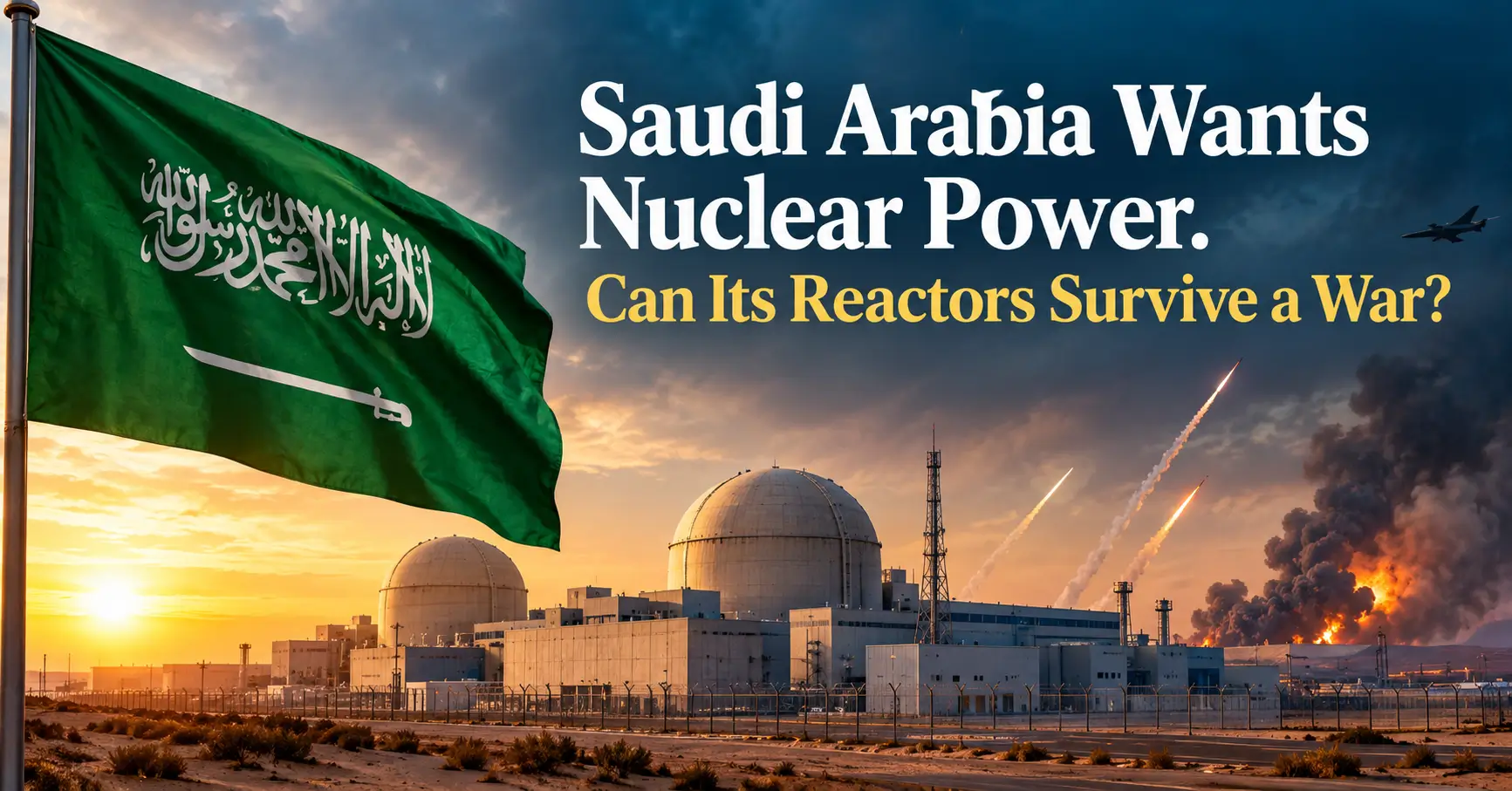
The deal about civil nuclear cooperation between the US and Saudi Arabia has stirred a concern not strictly about proliferation risks. A sudden missile or bomb attack on Saudi nuclear facilities could also unleash a big crisis involving radioactive materials.
Saudi Arabia Wants Nuclear Power. Can Its Reactors Survive a War?. On Thursday, Energy Secretary Chris Wright requested Congress to ratify a civilian nuclear cooperation agreement between the USA and Saudi Arabia. If Congress passes this law, the US is likely to export reactors to Saudi Arabia 90 days afterward. If a law blocks the agreement, the United States cannot do so.
However, prior to voting to open the gates of the reactors’ exports, the legislators will be better served to review the reason behind Russia’s decision not to keep as many staff as previously at the nuclear installations of Iran. After the war broke out at the end of February, Russia nearly all of its personnel from the Bushehr nuclear power plant. Then, in September, the country brought in a few employees to the site and ended up with 42 of them.
Such a measure of caution reflects the risks involved. On the night of May 17, 2026, Iran fired a drone at the U.S.-designed Barakah nuclear plant in Al Dhafra. Earlier, Iran said they had US-Israeli forces launching attacks inside or around the Bushehr nuclear installation four times.
Israel is a very familiar country in this game and the other actors such as the United States, Iran, and Iraq have been quite a few times on the offensive against the reactors from 1980 to 2007, and we can count at least 13 attacks! Also, the United States and Israel have been on an offensive against Iran’s nuclear fuel-production centers.
Nuclear Plans of Saudi Arabia are a Security Conundrum
Riyadh in partnership with Washington must seriously think about their nuclear energy plants which if constructed, could become targets of a regional conflict given this kind history. Saudi Arabia declares that they will at least be building one nuclear power plant and the country might be developing a program as big as 16 reactors. Experts foresee that several small modular reactors are going to be among them. Besides, Riyadh wants to enrich uranium within the national borders,
Experience shows the way it could be dangerous. Any of these sites might easily become military objectives, and there is no one that is going to know, how well they will withstand being under attack.
Potential Ways of the Nuclear Facilities Protection
- Nuclear sites face the danger of being attacked by drones, missiles, and other types of warfare.
- Passive protection might lower the sensitivity of some parts of the plant to such attacks.
- Redundant electricity supplies are a means of keeping up safety and cooling in a reactor.
- Air defenses of superior quality will be able to defend against some sort of missile attack, however, protection from ballistic missiles is hardly guaranteed.
- Strong and resistant facilities would result in better capability of keeping the spent fuel in the storage area for a long period of time.
- Emergency cooling systems may prevent major fires with nuclear power plants' leftover fuel.
- Spreading radioactive contamination in a big area would be another reason for evacuating huge numbers of residents.
- In addition, there is another matter to be worried about: that the development of Saudi's nuclear power program could also lead to nuclear proliferation.
Probing for Vulnerabilities in Nuclear Power Plants to Drone Strikes
The first line of defense in a nuclear facility may involve passive protections to defend against drone strikes.
For example, the UAE recently shielded one of its oil tank storages by covering it in a structure that resembles a cage/birdcage/mesh.</p>
Such cages have been employed in Ukraine to protect power plants from Russian drone attacks using similar techniques.
Passive protection however, represents only one layer of security. Besides, nuclear reactors heavily depend on a consistent electricity supply in order to operate safely.
Why is the Electrical Grid so Important?
To keep power flowing to the reactor and other safety-critical systems, Ukrainian authorities have also been working on reinforcing certain segments of their electric system
As in any other case, if other infrastructure is also destroyed or damaged during the fighting, then the only reliable electricity comes from a nuclear power generator, which is why it is so important to ensure the continuity of power supply.
Air Defenses Are Not Without Flaws
Nuclear reactor sites in Ukraine, Iran , and Belarus are heavily surrounded by air-defense systems actively defending. They can help prevent missile strikes delivered by aircraft.
Still, such defenses are not sufficient against ballistic missile attacks. This is exactly the reason why for most countries nuclear reactors should not be built in areas actively experiencing conflict. Saudi Arabia Wants Nuclear Power. Can Its Reactors Survive a War?
Making the AP-1000 Reactor More Resilient
We can also mention the Westinghouse AP-1000 reactor which the Kingdom of Saudi Arabia , may end up acquiring, in an entirely different manner. The structure of the containment and the separate storage facility for the spent fuel can survive pressures up to 6,000 pounds per square inch.
The level of protection offered by the design already shows a degree of resistance. Engineers, however, might consider reinforcing the storage area using ultra-high performance concrete.
This material could withstand pressure up to 40,000 pounds per square inch, which is considerably higher than the level that the containment vessel is designed to withstand.
Danger from the Nuclear Fuel Pool
Damage to the nuclear fuel storage facility as a result of a strike may lead to an unprecedented release of radioactive material and result in evacuation of possibly hundreds of thousands or millions of people. Such scenarios are still possible especially in view of the fact that modern ballistic missiles with penetrating warheads are capable of breaching concrete structures designed to withstand 30,000 pounds per square inch.
The National Research Council of the United States has been urging the installations of emergency spray-water cooling systems inside spent-fuel storage areas for quite some time now. These systems might be instrumental in preventing fires in spent nuclear fuel even in a scenario where attack damages the storage pit and empties its cooling water.
Saudi Arabia Is In Need Of An Overall Review Of Nuclear Security
Nuclear security measures in Saudi Arabia need an overall reassessment. Even if buildings are stronger, additional power lines available, passive protections on a scale, and emergency cooling systems installed are still far from complete, one fact remains, namely that during a war, no facility can promise to avoid the worst possible result。
It may still be surprising though to see that the subject is not getting much more attention. Saudi Arabia does not have nuclear facilities at all, the country has the resources for sun, gas, and oil in abundance.
Saudi Arabia Wants Nuclear Power. Can Its Reactors Survive a War?. Nuclear power seems to be at a crossroads where the necessity is driven by the energy demands of the population without a proper assessment of the risks involved for the country. It also causes some more anxiety as Saudi Arabia pursuing nuclear power brings in the threat of nuclear proliferation.
CSS Forum – Join Now