


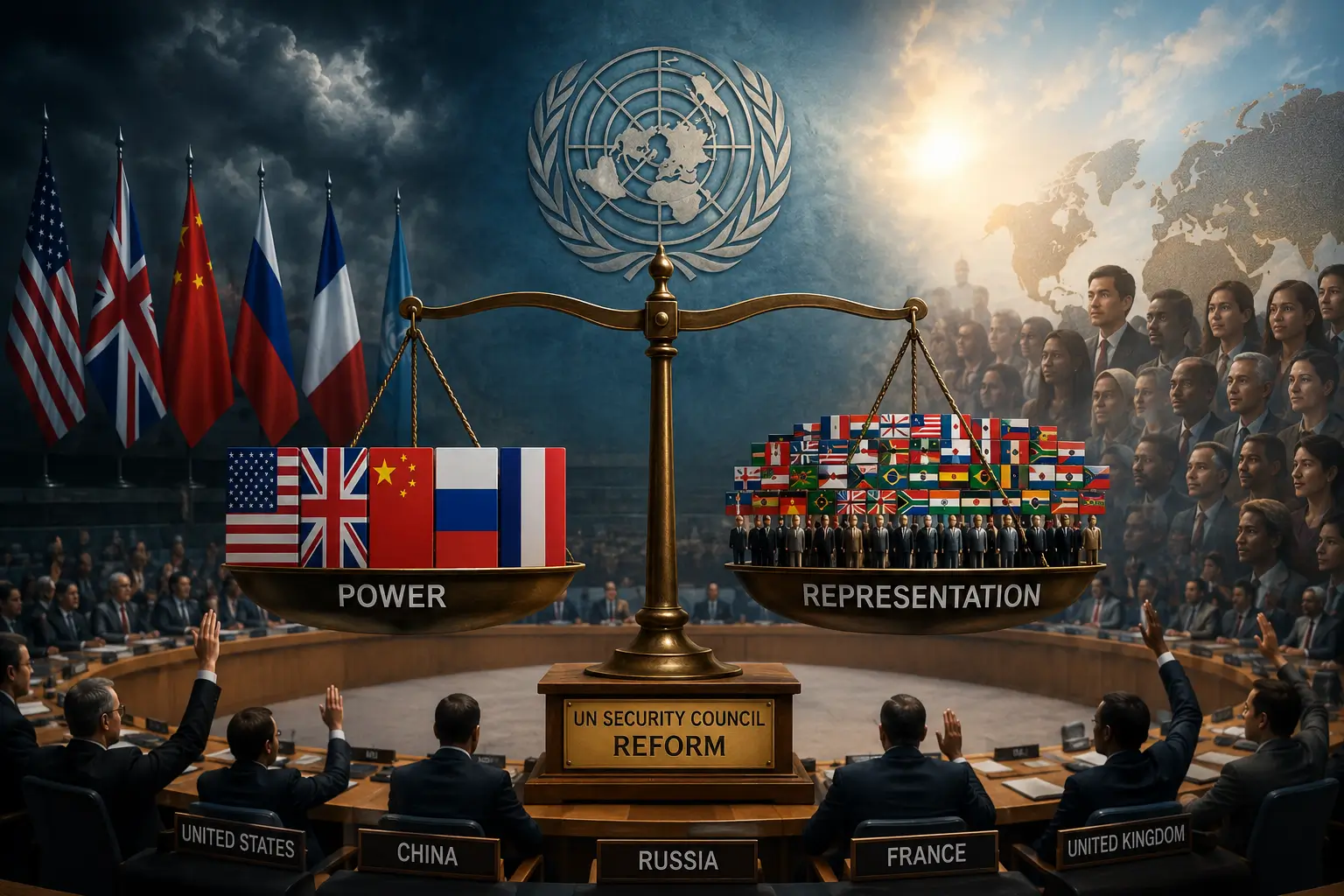
After the horrors of the Second World War, the United Nations was established in 1945 with the primary objective of maintaining international peace and security. However, its most powerful institution, the Security Council, was shaped according to the political realities of that era. The five permanent members (P5) were granted veto power to prevent confrontation among major powers and preserve international stability. Over time, however, this privilege has increasingly become an obstacle to effective and equitable decision-making.
Today, the world’s population has exceeded eight billion, and the United Nations has 193 member states. Yet the Security Council has witnessed no major structural change since 1965, when its membership was increased from 11 to 15. The world has changed dramatically, but the Council continues to reflect the geopolitical realities of the past. Africa, Latin America, Asia and other regions of the Global South, representing a large share of humanity, continue to demand greater participation in global decision-making.
To address this imbalance, the UN General Assembly initiated negotiations on Security Council reform in 2008 under the Intergovernmental Negotiations (IGN) framework. However, the process remains stalled because member states disagree over the nature of reform. The issue is not simply whether more seats should be added but whether the existing power structure can become more representative and accountable.
A system of rotating or periodically elected membership could also strengthen democratic accountability.
The G4 Brazil, Germany, India and Japan demand permanent membership, arguing that their populations, economies and international influence justify a greater role in the Council. The African Group meanwhile seeks two permanent seats and additional non-permanent seats to correct Africa’s historical underrepresentation.
The G4’s argument has considerable weight. The existing Council does not fully represent today’s global political and economic realities. However, an important question remains: would adding more permanent members actually make the Council more representative and effective? Granting additional states permanent status, particularly veto power, could create new centres of privilege and make decision-making even more difficult.
The existing veto system itself demonstrates the problem. The humanitarian crisis in Gaza has highlighted how vetoes and divisions among major powers can prevent the Council from producing effective outcomes. The history of the Council also shows that the interests of powerful states have frequently influenced its decisions. Expanding the same privileges could therefore increase rather than reduce institutional paralysis.
India’s case also illustrates the complexity of the debate. India presents itself as the world’s largest democracy and a major emerging power, arguing that its population, economy and international standing make it deserving of a permanent seat. However, concerns over human rights, particularly the situation in Jammu and Kashmir (IIOJK), the abrogation of Article 370 and disputes surrounding the Indus Waters Treaty raise questions about whether its conduct consistently reflects the principles expected of a permanent member. Allegations concerning minority rights and activities beyond its borders further complicate its claim.
Rather than simply creating additional permanent members, a more balanced model deserves consideration. One proposal is to expand the Council from 15 to 20 members with longer renewable terms and fair regional distribution. A system of rotating or periodically elected membership could also strengthen democratic accountability. Countries would gain greater representation through transparent elections while remaining answerable to the international community and their respective regions.
The fundamental objective of reform should therefore be to strengthen legal authority and accountability, not create new centres of privilege. Decisions affecting the entire international community should involve broader representation rather than remaining concentrated among a limited number of powerful states.
The world of today is fundamentally different from that of 1945. New states have emerged, economies have shifted, and regional powers have gained influence. If the United Nations is to remain credible and effective, its most important decision-making body must reflect these changing realities. The rights and interests of smaller and developing countries must also be protected.
Pakistan’s position in this debate is particularly significant. Pakistan has consistently supported a more representative and democratic Security Council and opposed the creation of new permanent privileges that could reinforce an already unequal system. Its position emphasises equitable geographical representation rather than the creation of additional centres of power.
Ultimately, Security Council reform is not merely a demand for more seats. It is a demand for a fairer international system based on representation, accountability and equality. If reform is genuinely intended to strengthen the United Nations, it must reflect the aspirations of the wider international community rather than simply expanding the privileges of a few powerful states. The future of reform will depend on whether the world chooses a system based on privilege or one founded on representation, accountability and democratic participation.
SOURCE:https://dailytimes.com.pk/1538730/un-security-council-reform-power-vs-representation/
CSS Forum – Join Now