


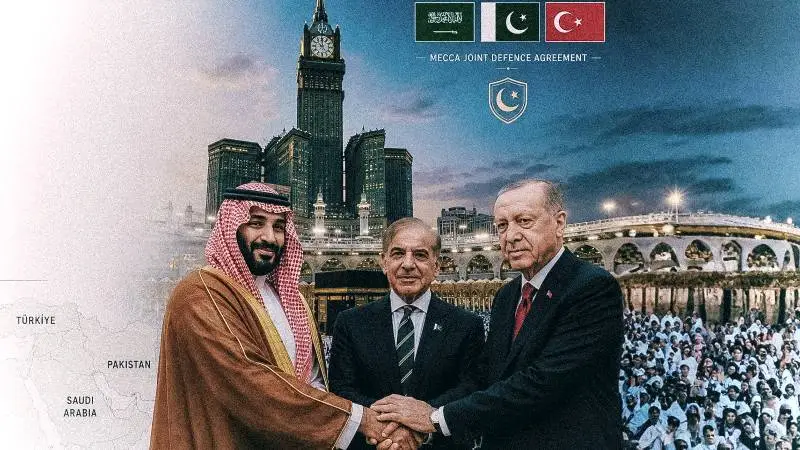
The Saudi Arabia-Türkiye-Pakistan defence pact is a watershed in regional security because it brings together three major Muslim states with complementary strengths and places collective defence at the centre of their relationship. Saudi Arabia brings financial resources and considerable political weight, Türkiye a formidable military and an increasingly sophisticated defence industry, and Pakistan a large professional military, strategic location and nuclear capability. At a time when the Middle East has been convulsed by wars, missile and drone attacks and growing doubts about the durability of existing security guarantees, the significance of this alignment should not be underestimated.
Pakistan and Saudi Arabia already have a Strategic Mutual Defence Agreement, signed last year, under which aggression against either country is considered aggression against both. Their military relationship is much older, stretching across decades of training, deployments and close institutional contacts. Türkiye's inclusion gives this relationship an entirely different dimension. It connects South Asia, the Gulf and a major NATO power, while bringing Turkish military technology and defence production into a relationship previously dominated by Pakistani manpower and Saudi resources.
The pact also reflects changes taking place across the region. For decades, Gulf security rested overwhelmingly on American power. That relationship is not disappearing, nor can any combination of regional states easily reproduce America's military, intelligence and logistical capabilities. But the experience of recent conflicts has persuaded regional governments that relying upon a single external guarantor carries risks. Saudi Arabia has consequently diversified its international relationships, Türkiye has pursued an increasingly autonomous foreign policy despite its NATO membership, and Pakistan has maintained close relations with China while rebuilding ties with Washington and deepening its partnerships with Riyadh and Ankara.
For Pakistan, this is an important opportunity. Islamabad has traditionally viewed national security through the prism of India, but its strategic interests extend far beyond South Asia. Millions of Pakistanis live and work in the Gulf, Saudi Arabia and the UAE are important economic partners, and developments in Iran and Afghanistan have immediate consequences at home. A formalised security relationship with Saudi Arabia and Türkiye increases Pakistan's diplomatic relevance at precisely the moment when regional alignments are being reconsidered.
The economic and defence-industrial opportunities may prove equally important. Türkiye has developed impressive capabilities in drones, missiles, naval platforms, electronic warfare and other technologies. Saudi Arabia has the financial resources and ambition to localise more of its enormous defence expenditure. Pakistan possesses an established defence industry, skilled manpower and relatively cost-effective production capacity. Joint ventures, technology transfers and co-production could therefore give the agreement an economic dimension that goes well beyond conventional military cooperation.
There is good reason, however, not to rush into descriptions of a “Muslim NATO”. NATO's credibility does not derive from Article 5 alone. It rests upon decades of integrated military command, common operational planning, intelligence-sharing, logistics and interoperability. The new trilateral arrangement has yet to develop such institutions. Its collective-defence commitment nevertheless has immediate deterrent value because any adversary contemplating an attack on one member must now calculate the possibility of confronting the other two. Joint exercises, intelligence coordination, military planning and cooperation on air and missile defence can gradually turn the political commitment into a credible security mechanism.
Iran presents the most delicate question for Pakistan. Islamabad cannot afford to allow this arrangement to become an anti-Iran alliance. Iran is a neighbour with which Pakistan shares a long border and significant security and economic interests, while Saudi Arabia remains one of Pakistan's closest strategic and economic partners. Pakistan has navigated this difficult balance for decades and should continue to do so. The pact should therefore be defined by what its members intend to defend rather than by identifying a permanent enemy. Indeed, a stronger Pakistan with good relations in Riyadh, Ankara and Tehran could potentially play a stabilising rather than polarising role in the region.
Israel will also watch this emerging alignment with considerable interest and some caution. None of the three countries has presented the pact as directed against Israel, and Saudi Arabia in particular will want to avoid that interpretation. Much will depend on how the pact evolves. If it remains essentially defensive, Israel may regard it as another feature of a changing regional order; if it develops a stronger military infrastructure or becomes entangled with the Palestinian question and future regional conflicts, Israeli concerns will inevitably grow. The three partners therefore have an interest in defining the pact carefully: as a mechanism for regional deterrence and stability rather than another axis of confrontation.
Washington is also unlikely to view greater regional burden-sharing as inherently hostile. American administrations have repeatedly urged allies to assume more responsibility for their own defence. Türkiye remains a NATO member, Saudi Arabia's military relationship with the United States remains extensive, and Pakistan has again become an important interlocutor for Washington. The more interesting development is that none of these countries now wishes to depend exclusively on one great power. Strategic autonomy does not require breaking with Washington; it means having choices.
Other Muslim-majority states may eventually find the arrangement attractive, particularly if the three founding members can demonstrate that it produces tangible security and economic benefits. Egypt, Qatar, the UAE, Jordan and Azerbaijan are obvious countries with which cooperation could expand, although each has different strategic interests and relationships. Expansion for its own sake would be a mistake. A compact arrangement that works is more valuable than an impressive list of members unable to agree on when or how collective defence should apply.
The immediate task, therefore, is to give substance to an ambitious political declaration. Saudi capital, Turkish technology and Pakistani military capability offer an unusually complementary combination. If the three governments can build joint planning mechanisms, deepen defence production, share intelligence and create credible procedures for responding to common threats, the pact could develop into the nucleus of a new regional security architecture.
CRISP: A New Strategic Platform For South, West And Central Asia
For much of the post-war period, the security architecture of the Middle East was designed elsewhere and guaranteed principally by outside powers. That era is not ending overnight, and American military power will remain indispensable for years to come. But something important has changed. Riyadh, Ankara and Islamabad are signalling that regional powers can also organise, deter and defend themselves. If they can translate that proposition from paper into institutions, this agreement will be remembered not simply as another defence pact but as the moment when an important new strategic triangle began to take shape.
Sourse:https://www.thefridaytimes.com/08-Aug-2026/beyond-american-umbrella-new-strategic-triangle-takes-shape
CSS Forum – Join Now
