


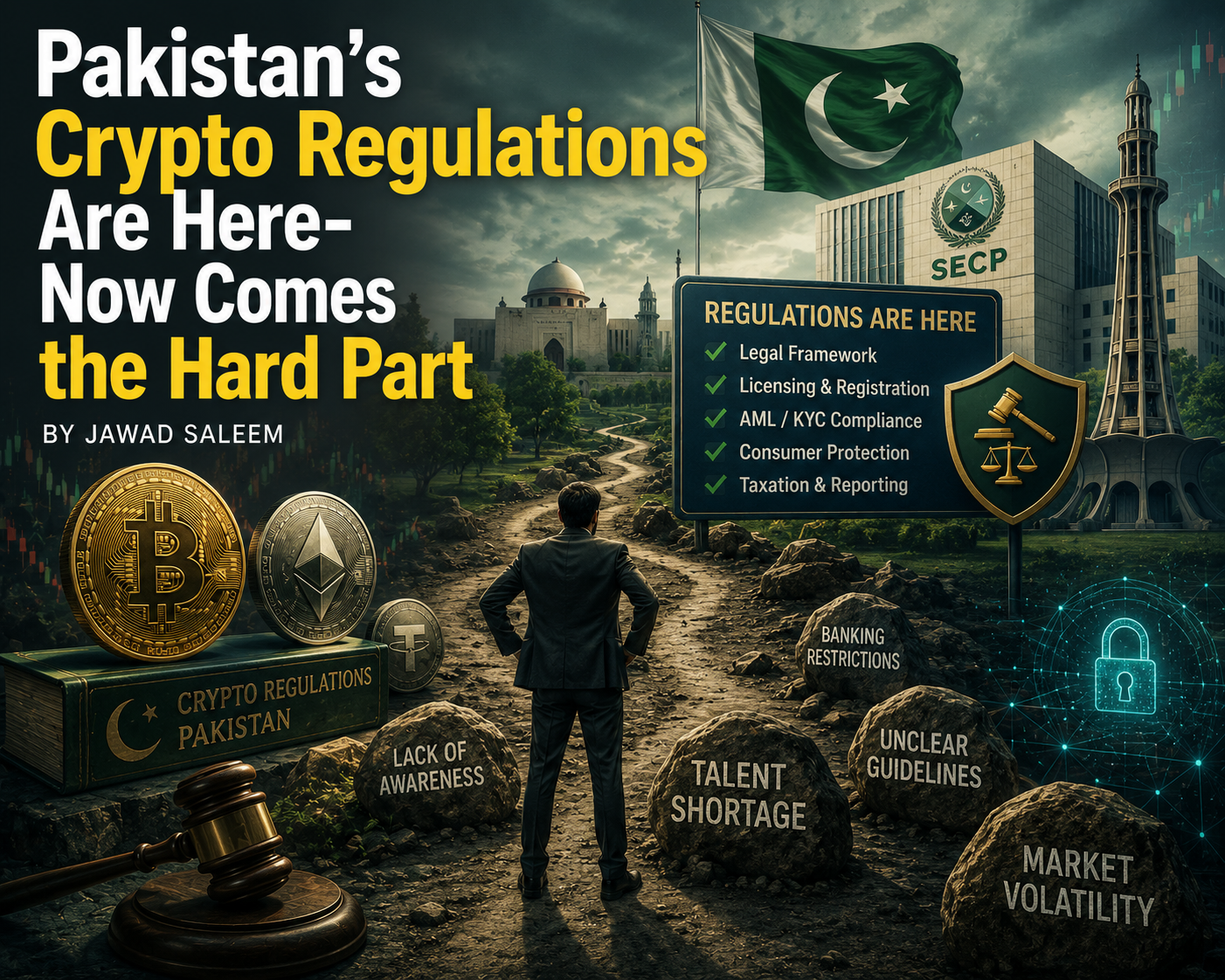
Pakistan’s cryptocurrency debate has finally moved beyond whether crypto should be allowed.
It is already here.
Pakistanis were buying Bitcoin, holding stablecoins, trading through offshore exchanges and settling peer-to-peer long before the state created a regulatory framework. The Virtual Assets Act 2026 therefore does not create Pakistan’s digital-asset economy. It attempts something harder: bringing an economy that developed outside the formal financial system inside it.
Pakistan now has the Pakistan Virtual Asset Regulatory Authority (PVARA), a statutory licensing framework and a regulatory perimeter covering exchanges, brokers, custodians, transfers, lending, derivatives, advisory and other virtual-asset activities. AML requirements, customer due diligence, custody standards and the FATF Travel Rule are being built into the system.
That is significant progress.
But writing crypto rules may prove to have been the easy part. Pakistan must now make five systems that were never designed to work together actually work together: virtual-asset regulation, banking, foreign exchange, taxation and AML enforcement.
Is Pakistan creating a domestic digital-asset industry or primarily a regulatory gateway for large international platforms?
Consider a Pakistani with PKR 1 million in his bank account who wants to buy Bitcoin through a licensed exchange.
The State Bank has allowed banks to maintain accounts for licensed virtual-asset service providers, including segregated client-money accounts. But these accounts are PKR-denominated, banks remain subject to Pakistan’s foreign-exchange regulations, and regulated financial institutions cannot simply start trading virtual assets on their own balance sheets.
So where does the foreign currency ultimately come from?
The question becomes more important with USDT or USDC. A dollar stablecoin may technically be a virtual asset, but economically it provides exposure to the US dollar. At scale, converting rupees into dollar-backed digital assets stops being merely a technology question. It becomes a foreign-exchange and potentially a balance-of-payments question.
Pakistan has spent decades controlling foreign-currency movement. Crypto can move value across borders in minutes.
Those realities will eventually collide.
This is also why stablecoins may matter more to Pakistan than Bitcoin. Bitcoin attracts attention because its price moves. Stablecoins can become payment rails, remittance instruments, cross-border settlement mechanisms and digital-dollar savings vehicles.South Asians & Diaspora
For a country receiving tens of billions of dollars annually in remittances, the opportunity is obvious. An overseas Pakistani could theoretically transfer value within seconds, at any hour, without waiting for conventional banking settlement.
The risk is equally obvious: if rupees can effortlessly become dollar stablecoins and leave the country, remittance technology can also become infrastructure for capital flight.
Pakistan therefore needs to distinguish productive digital-financial infrastructure from an unregulated parallel FX market.
Then comes perhaps the most immediate problem: what happens to crypto Pakistanis already own?
Imagine someone bought Bitcoin for $10,000 several years ago, traded through different exchanges and P2P markets, moved assets between wallets and now holds $50,000.
The blockchain may establish where the crypto moved. It does not necessarily establish where the original rupees came from.
That investor could represent three completely different cases: declared income with complete records; legitimate income with incomplete records because transactions occurred through informal channels; or undeclared and potentially illicit money.
A credible system must distinguish among them.
Treat the second like the third, and legitimate holders will avoid the regulated system. Allow historic crypto into banks without adequate source-of-funds checks, and Pakistan risks creating a digital whitening window.
PVARA and other authorities therefore need a practical framework for legacy holdings: acceptable evidence of acquisition, source-of-funds requirements, treatment of old wallet transactions and circumstances requiring enhanced due diligence.
Otherwise, difficult-to-document assets will simply remain offshore or P2P.
Taxation creates the next challenge.
Suppose Bitcoin bought for PKR 5 million is sold for PKR 8 million. Is the PKR 3 million capital gain, business income or another category?
Now exchange Bitcoin for Ethereum without returning to rupees. Has a taxable event occurred? What about conversion into USDT, staking income, mining rewards, crypto received as compensation, token distributions or losses against other digital-asset gains?
And how should acquisition cost be established for assets purchased years before regulation?
These are no longer niche accounting questions once regulated exchanges start reporting transactions.
India chose a highly explicit, if aggressive, model: a special 30 per cent tax regime for income from virtual digital assets with dedicated disclosure requirements. Pakistan need not copy India’s tax rate. It does need its certainty.South Asians & Diaspora
An investor should know the tax consequence before pressing “sell”, not after receiving a notice.
AML enforcement creates another paradox.
Pakistan is understandably constructing its regime around FATF standards. Licensed providers will face KYC, beneficial-ownership checks, transaction monitoring, sanctions screening and Travel Rule requirements.
But compliance has an economic price.
A customer can either use a licensed exchange, complete KYC, establish source of funds, transact through monitored banking channels and transfer traceable assets – or potentially find a P2P seller, transfer money directly and receive crypto into a self-custody wallet.
If the first route becomes substantially slower, more expensive or more intrusive without delivering meaningful advantages, activity will migrate toward the second.
Pakistan could then successfully regulate the regulated market while much of the real market remains outside it.
Good regulation should therefore not be measured by how difficult compliance becomes. It should be measured by how much legitimate economic activity voluntarily enters the compliant system.
The economics of licensing deserve similar scrutiny.
PVARA’s draft Virtual Asset Services Regulations propose capital requirements according to activity. At the upper end, exchanges and certain token issuers could require PKR 1 billion in paid-up capital; lending, borrowing and derivatives activities PKR 500 million; custody and several other activities also carry substantial thresholds.
These remain draft requirements and may change.
But they raise a strategic question: is Pakistan creating a domestic digital-asset industry or primarily a regulatory gateway for large international platforms?
PKR 1 billion may be manageable for a global exchange. It is formidable for a Pakistani fintech startup.
Capital requirements protect customers from weak operators. Set too high, however, they can concentrate an industry among a few large players before domestic firms have an opportunity to develop.
Custody creates another capability gap.
Traditional finance has established mechanisms for proving ownership. Digital assets rely on wallets and private keys. An auditor can obtain bank confirmation of cash. But who independently verifies that an exchange controls the Bitcoin addresses it claims to control? Who reconciles customer liabilities against on-chain reserves, tests private-key controls or verifies assets across hot and cold wallets?
Pakistan therefore needs more than exchanges. It needs blockchain investigators, digital-asset auditors, cybersecurity specialists, custody experts, compliance professionals and regulators capable of understanding what they supervise.South Asians & Diaspora
Done properly, that expertise could itself become an exportable professional-services industry.
And this brings us to the real economic opportunity.
The case for digital assets was never simply that Pakistanis should speculate on Bitcoin.
It is whether this infrastructure can make legitimate money move faster, cheaper and more transparently.
Pakistan receives enormous remittance flows, has millions of citizens overseas, a growing technology-services industry and businesses trading across borders. Regulated digital assets could potentially reduce remittance friction, improve settlement, enable tokenisation of real-world assets and create new investment products.
Eventually, even a properly regulated PKR-backed digital token could raise possibilities around instant merchant settlement, programmable payments and tokenised financial markets.
But that future requires coordination between PVARA, the State Bank, tax authorities, banks and law enforcement.
Otherwise, Pakistan could build five individually sensible regulatory systems that collectively make a legitimate transaction impossible.
That is the real test of the Virtual Assets Act.
Success will not be measured by how many licences PVARA issues. It will be when legitimate historic holdings can enter the system without their owners being presumed guilty; banks can service licensed exchanges without treating every transaction as toxic; investors know their tax liability before trading; regulators can distinguish remittances from capital flight; and customers prefer regulated exchanges over informal P2P markets.
Pakistan’s challenge is no longer whether crypto should exist. It already does.
The challenge is whether the state can bring an economy that grew outside the system inside it – without frightening legitimate money away, opening a laundering window, or accidentally creating a second dollar market.
That will require something much harder than passing a law.
It will require making the law work in the real world.
SOURCE:https://dailytimes.com.pk/1544412/pakistans-crypto-regulations-are-here-now-comes-the-hard-part/
CSS Forum – Join Now