


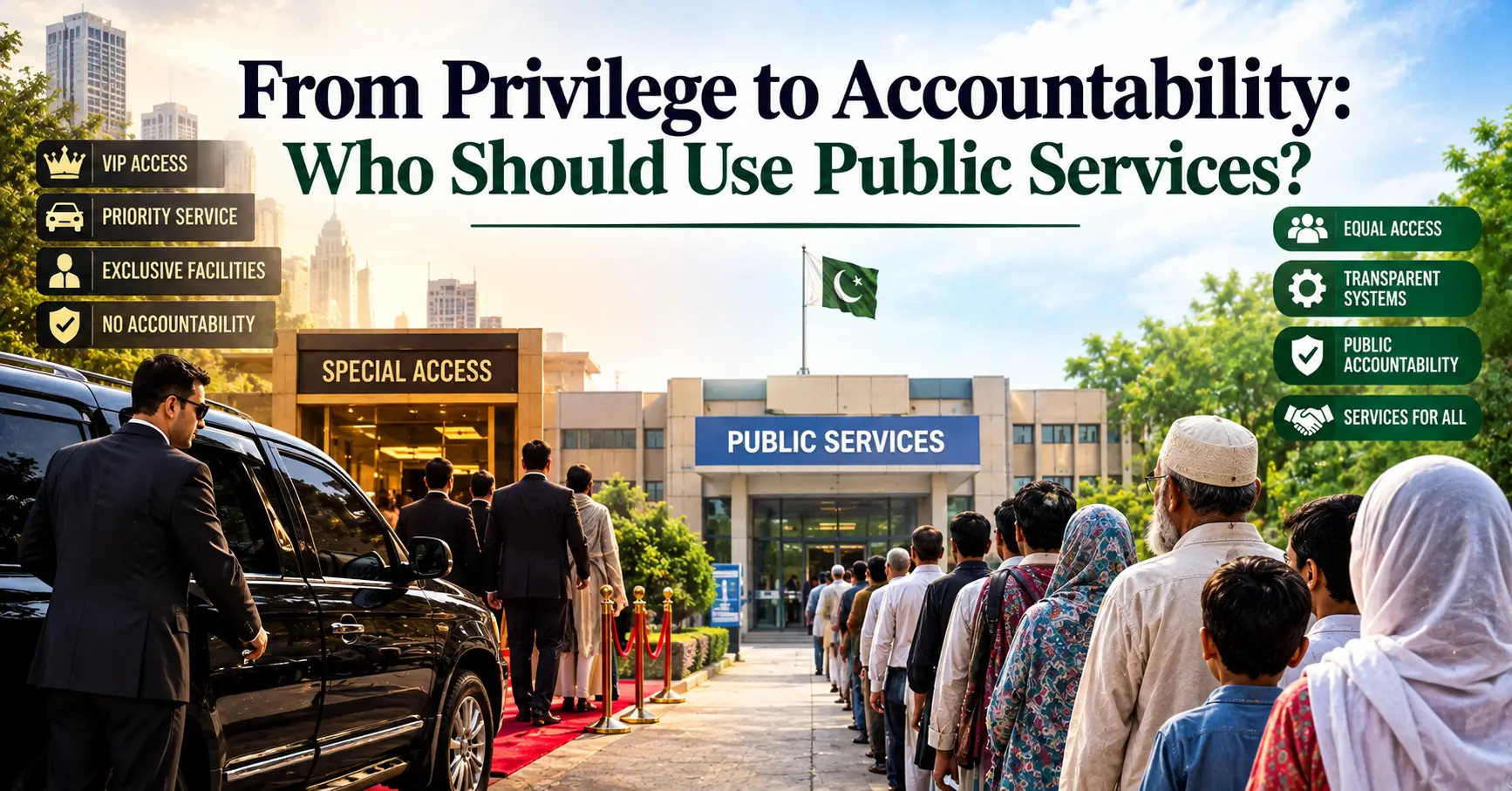
From Privilege to Accountability: Who Should Use Public Services?
From Privilege to Accountability: Who Should Use Public Services? Pakistan's recent discussion around the usage of public service has brought to the attention a crucial question: should it actually be the case that those entrusted with the management of public medical facilities, educational institutions, university and transport systems, also become the users of those services? A recent proposal from Senator Pervaiz Rashid suggests that those paid with the taxpayer's money, be it the head of the country or the bureaucrats at the higher level, can only use government-provided facilities and not private ones. He believes this is a good way to hold them accountable, and indeed the issue is a matter of public concern.
The Value of a Wider Experience and a Deeper Sense of Ownership
When leaders or bureaucrats have first-hand experience of what it's like, for instance, a person being rushed to the ER only to find out the hospital is overcrowded; or a person's kid starting school with the school facilities being a disaster; or when a government worker, in this case a transport office worker, is constantly having to report to different offices with transport from the city being a major problem and unreliable, they can actually be of help to other people. Furthermore, when they personally face such situations, this can push for real action and changes. Still, requiring such individuals to use public facilities only may pose issues such as medical emergencies or family-related situations, besides being a matter of constitutional rights and enforcement concerns. Hence, it is best to focus on the betterment of public institutions rather than solely on imposing penalties. From Privilege to Accountability: Who Should Use Public Services?
Lessons That Can Be Drawn from Other Countries
Several examples overseas can be of help. The UK, for example, and Canada have broad public healthcare systems. However, on the other hand, both of them do not compel their officials who, for one reason or another, use or even prefer to have private healthcare. The US and Australia, on the other hand, rely rather heavily on private alternative healthcare systems. However, even so, officials do not compel others to give up private alternative healthcare. Moreover, China has heavily invested in her hospitals, schools, and transport system. However, the general trend is not that public officials are compelled by these nations to abandon private alternatives. It seems that, at least among them, the focus has been on public service enhancement, regulation, and service quality. From Privilege to Accountability: Who Should Use Public Services?
This means that with proper investment from governments in the development and upkeep of these institutions, citizens become more confident, as they know that public institutions provide reliable and available alternatives.
Pakistan's Needs
At one time, the country used to have top-level universities, hospitals, and government employees who were highly qualified. Unfortunately, due to not getting the necessary attention and funding, plus the fact that the government has changed its mind a number of times and not been consistent in the decisions that it has made, private alternatives took off. It is true that, given those changes, the decision-makers of the country no longer really get to understand and relate to the day-to-day hassles of ordinary people. From Privilege to Accountability: Who Should Use Public Services?
At least in one area, public transport, the government is showing signs of moving back toward the public sector. It was the Chief Minister of Punjab, Maryam Nawaz Sharif, who was a leader in implementing a modern bus system powered by electricity as she felt it was necessary to increase accessibility to transportation by making bus travel cheap in the state of Punjab. The story with the other sectors of the public service also has room for improvement provided that investment is made at a steady rate, management is improved, and performance criteria are set that are clear, for instance.
Main Features
- Personal responsibility to serve: Leaders are expected to be the first to use the services of the very public facilities they are responsible for supervising.
- Quality public entities: Hospitals, schools, and transport sector shall have dependable quality benchmarks.
- Non-compulsory: Officials would take the public services because they have faith in them and are not forced to do it.
- Long term financial backing: Authorities have to consistently finance and plan.
- Performance transparency: Government bodies are required to publicly report and keep track of benchmarks.
- Enhanced working environments: Doctors and teachers in the public system should be given their dues through proper support.
- Political will: Even when people are not in elections and their mandate has not been freshly won through the people's vote, delivering services shall remain high on the agenda.
Choice, Not Force
In fact, the country really requires that all the public service quality be brought up to a single level, to citizens and top-ranking officials alike. If the highest-ranking officials decide that they would be better for themselves to take care of their health in public hospitals, to educate their children in public schools, to travel in public transport, then they show that they have confidence in the quality of services. As a result of these direct experiences, they are capable of putting an even greater pressure for improvement.
Hence, Pervaiz Rashid is spot on in highlighting the main issue. The problem should not be solved by forcing top-ranking officials to patronize services that are of poor quality just to make them take responsibility. On the contrary, by building facilities that they are proud to choose for the family or themselves, Pakistan will show how serious it is to its people. From Privilege to Accountability: Who Should Use Public Services?
After all, the quality of public services is an ingredient that can help build trust and improve the transparency and responsibility level if the public servants perform their roles effectively. What is more, it is also the only way to prove that the money of all taxpayers, public or private, goes into financing an equal system, and everyone is getting the same level of quality.
CSS Forum – Join Now