


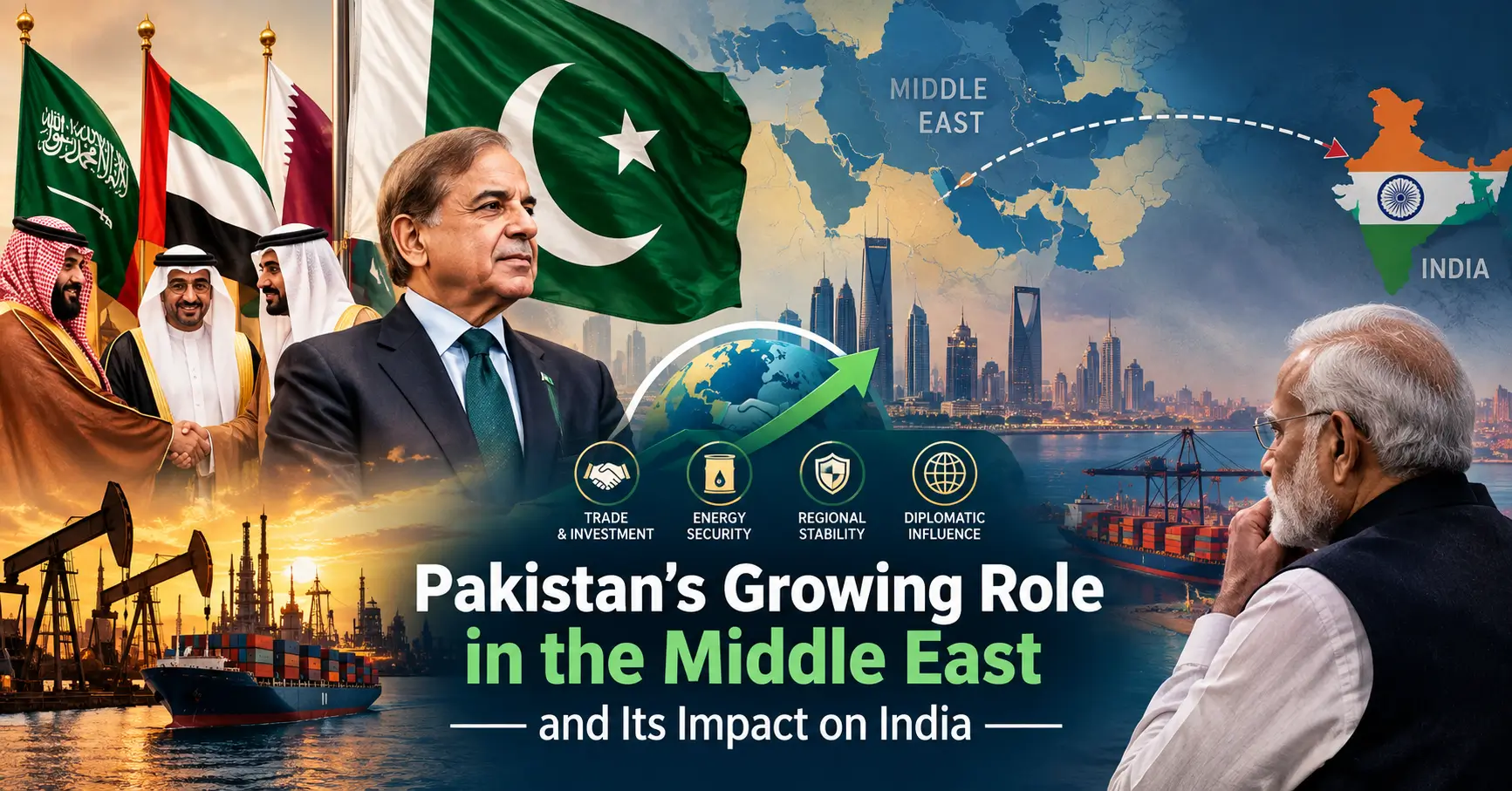
Pakistan’s Growing Role in the Middle East and Its Impact on India
Pakistan’s Growing Role in the Middle East and Its Impact on India Islamabad may get a chance to expand its sphere of influence, which will be beneficial to the whole region, but with that expansion also there would be certain risks like Pakistan becoming much more vulnerable to India. Last month, Pakistan’s increasing role in the strategic affairs of the Middle East got a new boost when it inked the ” Protocol-2026
” agreement with Kuwait, which is going to significantly expand the military cooperation framework that they began in 2023’s Defence Cooperation Agreement. Under the terms of the agreement, Pakistan is going to assist Kuwait with training, capacity building, border management, and other forms of defense cooperation. Just about a week after Pakistan became the fourth member of the more significant collective-defense agreement , signed by Saudi Arabia and Turkey, this accord with Kuwait marks the third move that highlights Pakistan’s growing involvement in Middle East security affairs. Pakistan’s Growing Role in the Middle East and Its Impact on India
The change of course of Pakistan in the Middle East is likely to bring them certain advantages, not only in the West but also in the diplomatic sphere. Their military cooperation is going to give it additional depth and the strengthening of their political and economic ties with the region’s powers will be a great tool in the power game they have with India. However, one of the possibilities deserves attention which is as follows: If Pakistan becomes deeply committed to the Middle East’s unstable politics, their strategic attention could get diverted to a large extent from India and the Kashmir conflict. Even more seriously, Islamabad will be so involved in the affairs of Middle East that what was originally a gain could become a drawback.
The August 7 document signed with Saudi Arabia & Turkey provides a better view of what was meant by the first kind of benefit: The signatory country attacked will be considered an attack against the other two. The cooperation agreement integrates Saudi financial strength, Turkey’s mighty conventional military forces, and defense industries with Pakistan’s large military forces and nuclear status. The arrangement is not a Middle East NATO yet, but it is certainly a notable step towards establishing an inter-regional security structure which will be the least reliant on U.S.
Islamabad gets a great chance to extend its influence Credits: National Interest
The Middle East joint-defense agreements are only going to be the first step in Pakistan’s westward shift. After signing the joint-defense agreements, Pakistan will be allowed even more freedoms in dealing with regional powers. As Pakistan’s growing military, economic and diplomatic relations with the Gulf Arabs have not been accompanied by any major decline in its ties with Iran, the country has the flexibility to act as a mediator between Tehran and the U.S. In particular, it has been able to balance its support for Saudi in Iran-related tensions and retain enough good relations with Tehran to serve as a bridge. In addition, Washington relations have been improving thanks to Trump and Asim Munir. Moreover, Pakistan also has a large, over 500 mile long, border with Iran and there are recent signs that cross-border attacks will become rare or non-existent if the two countries manage to solve their problems.Pakistan’s Growing Role in the Middle East and Its Impact on India
Military cooperation was an avenue through which Pakistan was able to project itself as a regional power.
Pakistan forged military protocol and agreements with Gulf countries such as Saudi Arabia, Kuwait, United Arab Emirates and other Muslim states from the late sixties. In addition to training their militaries, Pakistan helped these countries develop their air forces. During the period of the 1970s and 1980s, thousands of men from the Pakistan Armed Forces were deployed in the Kingdom of Saudi Arabia.
Saudi Arabia was the backbone of this cooperation. The Saudis gave Pakistan not only large quantities of money but also provided oil as well as political support whereas Pakistan offered Saudi security forces military men, training and expertise. This cooperation was further fortified during the time of anti-Soviet Afghanistan where together, Saudi Arabia and Pakistan became key players behind a major American-backed operation against communism and Moscow respectively.
The relationship survived many differences and misunderstandings too. It was in 2015 that the most important event happened when Pakistan's Parliament rejected
the invitation of Saudi Arabia to join the coalition in Yemen war against the Houthis. Islamabad was aware of the fact that if they went head-on in this confrontation, it could lead to internal instability in Pakistan itself due to a sizeable Shia community. The occurrence proved yet another aspect of what has been a feature of Pakistani foreign policy: maintaining good relations with Middle Eastern regimes without getting entangled with the regional rivalries such as the one with Iran.
Although this latest development is a direct continuation of the previous pattern of collaboration, it has an unprecedented scale. It's not just that Islamabad is supplying trainers and advisory personnel anymore; it is Pakistan’s involvement at the strategic level with three Mecca Pact members, Saudi Arabia being one of them, that has led to the creation of a stronger institutional setup. At the defense and foreign ministers and military chiefs meeting which took place at Istanbul on 31 August, the three countries expressed their readiness
to set-up of a secretariat in沙特 Arabia where Pakistan will provide the secretary-general for three years and to develop weapons so that they could be inter-op with each other and also to make defense-industrial joint initiatives.
India finds this issue to have two possible meanings which could conflict. To give an example, one of these might be to be concerned for New Delhi. In general, the Middle East and Pakistani countries are quite close. Therefore, a Pakistan that is more closely woven into the Middle Eastern security networks could be much more capable strategically of dealing with various external pressures in the region and that is a big challenge for India to tackle if such a situation arose. Thus, having Islamabad at a standoff with an increased room of resilience to Indian diplomatic moves and military pressure might be a real problem for Delhi. Pakistan’s Growing Role in the Middle East and Its Impact on India
Turkey has turned out to be a big supporter of Pakistan on the issue of Kashmir. In particular, the country has given Pakistan quite an amount of different types of weaponry, including drones, and other defense items that were very helpful for Pakistan when they came on the market. Whereas Saudi Arabia for its part had always been rather reserved in terms of getting involved into the India-Pakistan conflicts, particularly as their trade relationship with India was very strong and expanding, this new formal defense relationship may create certain kinds of links that could well prove to be decisive if and when India-Pakistan dispute reaches a crisis phase again. This way, it is the formal defense relations that provide the necessary institutional framework.
The nuclear issue is also one of the factors. Pakistan is still the Muslim-majority country with nuclear weapons. One should consider the possibility of Pakistan offering nuclear guarantees to Saudi Arabia with a grain of salt before there is any evidence for that. Pakistan’s possession of nuclear weapons, especially against the backdrop of a nuclear-armed Israel, will inevitably boost the perceived strategic value of Pakistan for Gulf partners and Turkey (which is also increasingly viewing Israel as a strategic rival).
Consequently, as that value escalates, so might the diplomatic leverage of Islamabad both domestically and globally with regard to India. Therefore, New Delhi cannot just disregard the significance and effect of Pakistan’s growing presence to the west on the regional South Asian balance.
Of course, the flip side also has some weight. The transition from strategic depth to strategic overstretch can be quite sudden, indeed. The Middle East is certainly a region where external actors get too deep without paying huge financial costs. It is very clear that Pakistan is juggling an extremely sophisticated network of alliances. One the hand, Islamabad is in the camp of Saudi Arabia who's main regional enemy is still Iran and yet, Pakistan is trying to work a peace between Iran and the United States. One the other hand, Pakistan is forging a new strategic partnership with the Republic of Turkey while keeping ties with various Arab states many of whose policy lines differ from Ankara's.
What is more, the relations between Pakistan and Gulf monarchies have intensified and those of Pakistan with these Gulf countries include the security issues involving conflicts with the Houthis, who also are a close rival to the state of Iran, precisely the kind of situations that Islamabad never wanted to get themselves involved. The fact is, Pakistan has consistently avoided being entangled into the conflicts among various groups and states in the Yemeni issue.
If such contradictory situations are further aggravated when the latest of Pakistan's security pledges are tested under duress, they are likely being already put on a hot burner with the increase in Saudi-Houthi tensions
. The Houthis have been not only blocking the Bab el-Mandeb
but also launching attacks on Saudi targets in the south of the country. Thepakistan foreign ministry stated
that Pakistan will not take any action to assist Saudi Arabia despite the fact that Islamabad remains committed to fulfilling the conditions of the Mecca Pact. However, if the fighting continues to escalate into a complete war, Islamabad would, most likely, be forced to choose between Riyadh and Tehran, the latter which, besides, is the most influential backer for the Houthis.
Diplomacy-wise, the deeper the presence of Pakistan in the Middle Eastern security scene becomes, the harder it to uphold the neutrality. That move might benefit India. From time immemorial, Pakistan’s military elite had concentrated mostly on India, with Kashmir serving as the centerpiece of its security policy. But if Pakistan is to expend major diplomatic, military, and intelligence resources in dealing with its situation in the Gulf and western frontier at the expense of its India focus, maybe it will not get enough from these efforts to keep the same level of pressure on India.
In the Middle East, the Pakistani role has obviously made Islamabad more important internationally and regionally. Pakistan’s expanding involvement is an asset that can bring Islamabad extra income, extra diplomacy power, and to some extent, it will give Islamabad the advantage of strategic distance when it comes to a confrontation with India. But when a nation tries to insert itself into a place dominated by some of the fiercest rivalries in the world, then strategic depth becomes, ironically, a trap.
CSS Forum – Join Now