


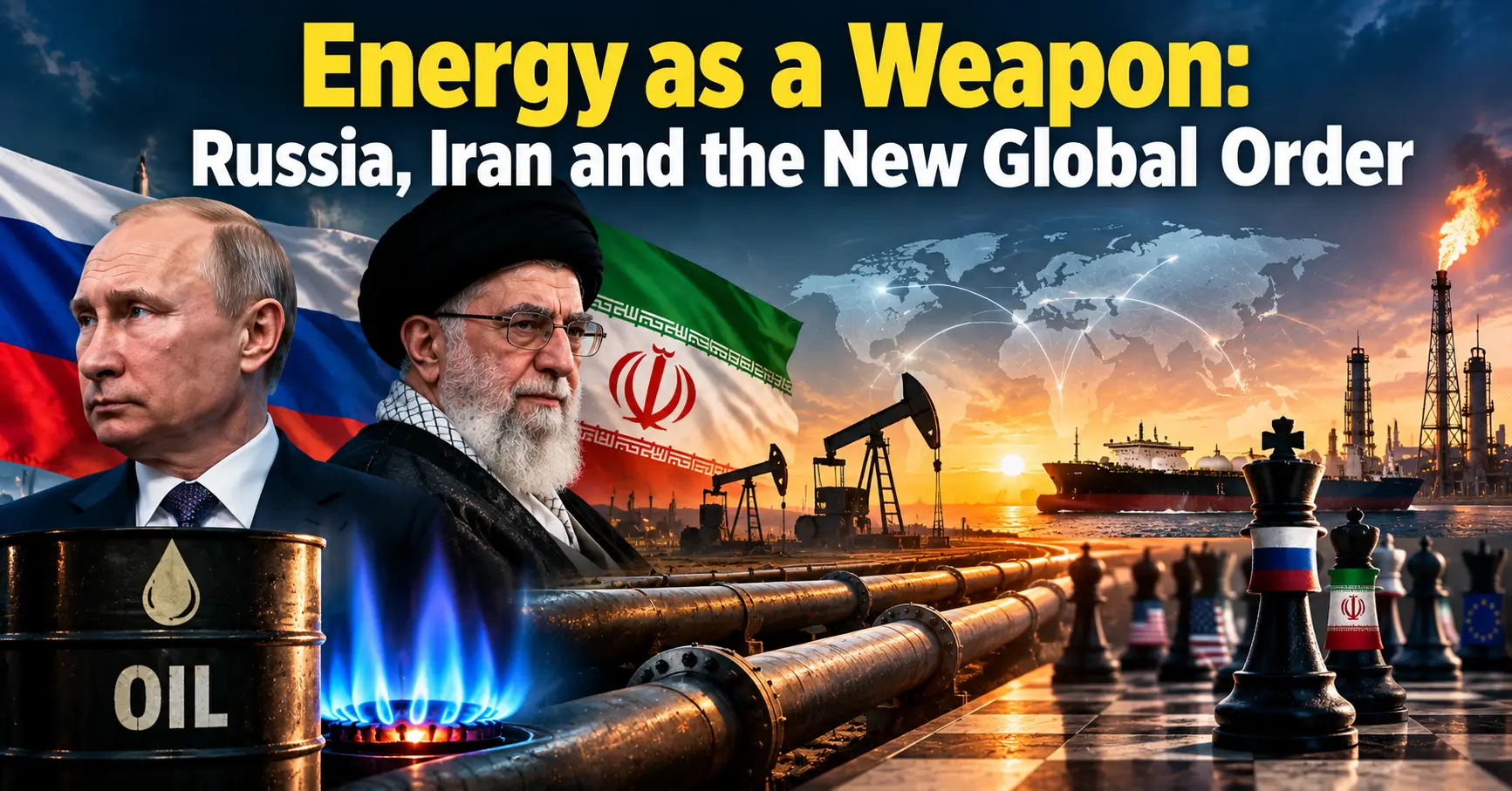
Energy as a Weapon: Russia, Iran and the New Global Order
Energy as a Weapon: Russia, Iran and the New Global Order
Energy as a Weapon: Russia, Iran and the New Global Order States always act according to what they think is in their national interest. For the entire twentieth Century the collective West did not deviate from their course. Even the West continues pursuing actions and measures with the goal of influencing world geoeconomics and geopolitics. If that is the case, shouldn’t Russia be faulted for following its own interests like the others? Russia and Iran are two wars going on right now and they are also reshaping the emerging global order. Global politics went into a new phase beginning with Donald Trump who was not only US President but also a very active international leader. The US under Trump has been going after the very goal of changing global geoeconomics and geopolitics, which has led to collective strategy in Western world through its transatlantic partnership.
No one will question that Russia and Iran are among the top targets of the West’s strategic goal, and China might well be next on that list.
To realize this aim, a gray territory that is not formally recognized as a state still has the basic structure of governance has already been formed. Two different gray zones are now on the list, the first is Ukraine and the other is the Arabian Peninsula.
Both places are in areas where the United States is still the dominating power: Ukraine is the buffer between the Russian empire and Europe, the Arabian Peninsula is a gateway between Israel and Arab countries.
Ukraine was officially in a state of martial law ever以来2022, but its government remains functioning by Ukrainian Constitution, although it didn’t hold a parliamentary election in 2023 nor a presidential one in 2024. All of this makes it a country in gray zone status at war with the war in its territory planned and supported mainly by the collective West.
The fact that there’s an ongoing dispute over the Strait of Hormuz and, not long ago, Bab-el-Mandeb shows that the Arabian Peninsula is a gray zone geographic area as well.
The gray-zone strategy which mainly targets Russia and Iran both being countries of significant oil production. However, while they share the common advantage of having substantial reserves of fossil fuels, their respective vulnerabilities related to energy resources are quite different. In Russia, the most important parts of the energy sector have been placed quite far from the fighting fronts; in contrast, in Iran, a lot of that part of the sector is actually in or near areas that are under threat directly by the front line. Energy as a Weapon: Russia, Iran and the New Global Order
Consequently, the Western nations combined are using grey zone tactics against the two countries. What marks this strategy is deliberate ambiguity.
The ultimate goal in Russia's situation is to make her bear costs but not carry out actions that could lead to a confrontation through a direct conventional military retaliation from the collective West. As for Iran, the goal is to undermine the country slowly but still keep the American reaction's nature and magnitude under a veil of mystery so that that uncertainty carries on throughout the midterm elections.
The energy resource is utilized in both regions as one of the main political levers which increases the cost factors of political and economic nature together with military one to the extent, making the situation even more escalated. This is another benefit to the Western defence industries, mainly those in the US, since a need to be prepared is created by this strategy which results in a better demand for high-tech military skills. Energy as a Weapon: Russia, Iran and the New Global Order
At the same time, however, Gulf countries are still trying to get more advanced military assistance from the US and Europe. As an example of this strong demand the US recently granted their blessing to Saudi Arabia for a 24.3 billion dollar deal for the sale of F-35 jets.
This gray-zone policy primarily intends to hinder the financial and logistical capabilities of Iran and Russia to carry wars by putting pressure on their revenues from petroleum exports. Of course, it's not a new idea that a country can use its energy resource as a tool for coercion. For instance, Joseph Stalin, the Soviet leader, acknowledged in part that the Allied's victory against Nazi Germany was due to the Red Army's success in cutting off Hitler's access to the Caucasian oilfields.
1973's oil boycott triggered by the Arabs brought gas price inflation in the U.S. by about 300 percent as a result. However, it must be realized the energy weaponization is coming back yet that, by turning energy into a weapon, it is the public who suffers a great deal without the expected strategic outcome even being realized. Energy as a Weapon: Russia, Iran and the New Global Order
Actually, the Arab oil embargo did not make the West turn against Israel. Just like the case of Hitler, even after his defeat, NATO's eastward expansion once again brought warfare to the border.
This argument is that Ukraine is not violating international law. Ukraine's reason for carrying out strikes on the oil infrastructure of Russia is that they target an economic industry that provides direct support of the Russian war effort. Through the interruption of the oil refining and processing facilities, Ukraine is planning to impose economic pressure on Russia, making oil products expensive in Russia, reducing oil revenues of Russia and eventually, limiting capacity of Moscow to fund the war. On the other hand, when Iran uses a similar line of reasoning for its attacks on US military or energy installations it considers to be aiding the US war against it, it faces a very different response. Iran is portrayed either as a pariah or as a rogue state that violates international law. This shows more than just the issue; namely the question whether international law, which is meant to be an impartial tool for all states, or the rules-based international order at all, is really equally available. Energy as a Weapon: Russia, Iran and the New Global Order
Differentiating between the treatment met by countries is an example of this inconsistency.
russians and iranians are condemned for their escalation in return but israelis for their actions are receiving an entirely different response. In particular israel's refusal to seek de-escalation in gaza has been interpreted by the west as an indication of different attitude than others.
The great power rivalry resurging coupled with the use of energy being weaponized gives states fresh openings to employ energy as a means of power and for achieving foreign policy goals. In this new context, policymakers need to assess again the relationship between energy security, foreign policy and national security so that they avoid facing their own energy Pearl Harbors” or “energy 9/11s. For Pakistan, the consequences are particularly crucial. The Ministry of Defence announced the Makkah Defence Pact was “at the stage of its implementation”. Hence, the pot seems to have been boiling, however, nobody knows what is inside yet. This uncertainty points out that Pakistan has to revive its democratic tradition of open discussion on foreign-policy and national security issues. An elected parliament should have the capability to discuss decisions that might impact the country politically and diplomatically on a very long lasting basis).
Pakistan might be able to cover its energy requirement through three significant sources – Russia, Iran and Saudi Arabia.
CSS Forum – Join Now