


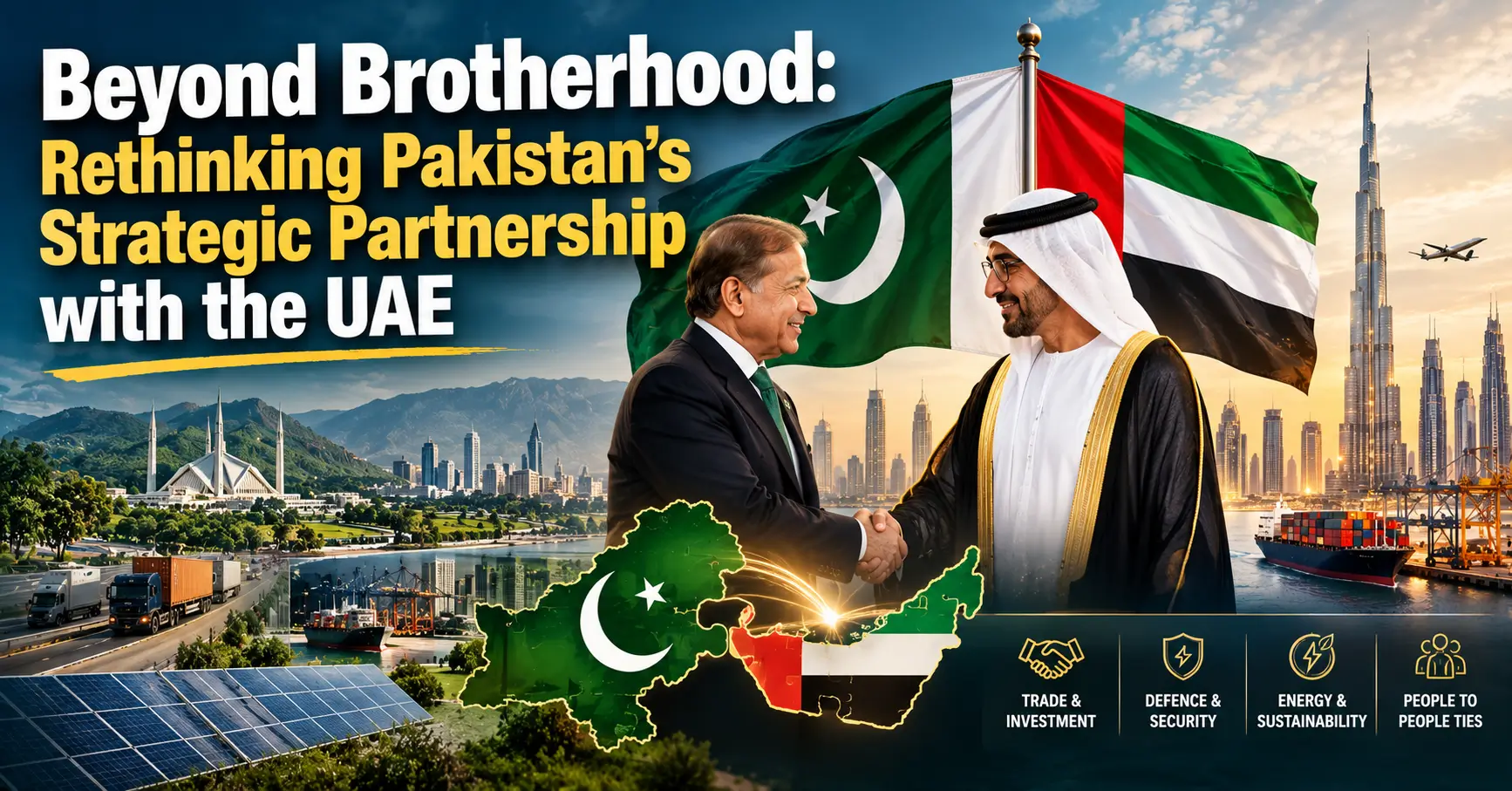
Beyond Brotherhood: Rethinking Pakistan’s Strategic Partnership with the UAE
Beyond Brotherhood: Rethinking Pakistan’s Strategic Partnership with the UAE
Beyond Brotherhood: Rethinking Pakistan’s Strategic Partnership with the UAE Pakistan has had relations with the United Arab Emirates for many years before most parts of the world started scrambling for a piece of the pie too.
One year after the federation was established, in the year 1971, Pakistan was one of the very few countries that recognized the newly-established state and also forged diplomatic ties.
The UAE did not only not have Emirates or Etihad aircraft flying the world or the Sheikh Zayed Road with tower blocks, or the Dubai skyscrapers, etc., but it did not even have a developed sovereign wealth fund like the type which would grab the attention from Washington to New Delhi. The UAE was still quite a new country building its institutions on its own and Pakistanis were already contributing to this process.
By April of 1974, about 115 Pakistani officers were working in the Abu Dhabi Defence Force. Pakistani pilots were teaching pilot training to Emirati recruits, besides which, military people took the role instructors, counsellors and commanders. The巴基斯坦 Army also was of help in establishing an armoured training school. According to historical documents, the first five heads of the UAE Air Force were Pakistani Air Force officers. Soon after, Engineers, teachers, administrators and other skilled workers became a part of the UAE's workforce that was expanding. Beyond Brotherhood: Rethinking Pakistan’s Strategic Partnership with the UAE
This piece of shared history of the two nations is not just an emotional souvenir of the days we had passed. Rather, it goes a long way in explaining why the diplomatic relationship between Pakistan-UAE has generally withstood diplomatic gossips and political differences that from time to time arise on the two sides in Islamabad and Dubai.
It goes back over 50 years since the beginning of co-operation. All the three have been tested on several occasions: war; economic crises; and changes in the alliance of different parties. So the question now is how Pakistan is to make that history into a sort of strategic inter-dependence at a more deep level.
Hence, this is just another reason why we should not look at this partnership as one that is to be automatic, or rather self-operating.
The United Arab Emirates, to which in the beginning, Pakistan had offered political, and perhaps even material, support during its development and growth, is nowadays a leading financial center with investments throughout the world. Today, it does business at the same time with the most powerful and diverse players: United States, China, India, Russia, Iran and Israel. Obviously, it enjoys having many options.
Thus, what the Pakistan-UAE joint diplomatic effort is to work to, is that rather than reminding continuously to Abu Dhabi of their being brothers, they should rely more on making the connection a strong economic and political one that will remain useful and valid for half a century or even longer.
The matter became quite significant for the entire year as the news about Pakistani deportations, employment restrictions, Emirati deposits, and UAE-India ties expanding all caused rumors of a big breakdown between Pakistan and UAE to circulate. Pakistan denied those allegations. A few months ago, the Foreign Office said that we should not make ourselves a target by engaging in a “divide-and-rule” strategy. Later this month, a correspondent, who during another meeting, inquired whether Pakistan had approached the UAE to “reset” relations, was answered with a rather subtle remark by the spokesperson: “The ties are set; so why to reset?”
Approximately 2.2 million Pakistanis currently live the UAE and it was reported that in the financial year 2022-23 the money that they sent home was around $8.7 billion.
This, however, goes much beyond simply numbers in a State Bank chart. These are real people: a driver who gets up before sun rise in Dubai; a surgeon working in Abu Dhabi; an engineer or a mechanic or a banker or a teacher or a restaurateur or a pilot or an accountant or a software professional earning their lives there – each of that group of a few million Pakistanis living in UAE has some form of a connection.
For families of over 10 million Pakistanis, the UAE is far from an abstract geopolitical relationship with another country. It is something tangible: that means being able to afford rent, school and medical fees, having money in time for the EID celebration etc. Beyond Brotherhood: Rethinking Pakistan’s Strategic Partnership with the UAE
Pakistan has been a major source of expatriate remittances to the UAE as a matter of fact. It is not only the money sent by millions of Pakistanis that have been in the UAE, but also other kinds of help such as Pakistan providing a military training program to the UAE when in the early days of UAE, a lot of their armed forces were trained in different military schools of countries that at that time had no relations with UAE.
In the context of remittances, Pakistan is the number one partner of UAE. According to a joint report by World Bank and UN, remittances made by expatriates to their countries of origin, have become in the case of Pakistan and many other developing countries, a major source of foreign exchange.
Nonetheless, the traditional method of economic growth is now facing its restrictions. Pakistan can no longer primarily export manpower such as drivers, electricians and construction workers while UAE has invested huge sums in emerging technology industries, including artificial intelligence, data centers, fintech, aerospace and advanced manufacturing. Having a large number of over 2 million self-employed workers and about 26,000 registered InformationTechnology, and ITeS companies in Pakistan, emphasis should gradually be put on security specialists, AI software engineers, aviation technicians, and international digital services. Beyond Brotherhood: Rethinking Pakistan’s Strategic Partnership with the UAE
Already, UAE has become Pakistan's third largest trading partner. In FY2025-26, commercial trade between the two countries has reached around USD 10.5 billion but Pakistan’s exports have been a mere USD 2.1 billion plus a little. In the past 20 years, UAE investment in Pakistan has gone past USD 10 billion. This situation is an issue of great concern for Pakistani policymakers.
Signing a Comprehensive Economic Partnership Agreement that could push bilateral trade towards $16-20 billion will only benefit maximum when Pakistan utilizes it to export rather than just increase imports. Dubai will be the distribution hub of Pakistani goods going into Africa and parts of the Middle East. Emirati investment will also be directed to sectors that generate exports rather than repeatedly being seen as deposits when Pakistan's foreign exchange reserves are under pressure.
The recently held 12th Joint Ministerial Commission meeting gave positive impressions on issues of investment, food security, technological development, and joint efforts in Artificial Intelligence and the digital economy. However, Pakistan’s usual challenge starts as soon as the agreement is signed.
Country hardly ever runs out of idea papers or opportunity papers. Its problem is in implementing the opportunities into real projects.
Investors see the advantages Pakistan offers – size of the population, unique position on the map, and rich mining resources. However their more pressing concern are: who will allocate land, how quickly a connection to the electric grid will be made, if the investors will be allowed to repatriate profits, and who will be the problem solver when a local department adds an extra approval requirement to a project six months after it is launched.
The field of agriculture is the best area to show a different behavior.
Wheat production and rice production were 29.61 million tonnes and nearly 10 million tonnes respectively in FY2025-26, agriculture grew by 2.89 per cent and livestock by 3.75 per cent. Meanwhile, reliance on food supply lines overseas continues to be an issue for UAE.
Another shipment of rice being exported simply would be the least imaginative way. Pakistani agriculture could get a boost if Emirati investment helped in modern irrigation, livestock production, cold chain storage, food processing, packaging and logistics. That would enhance Gulf food security and at the same time will add to an increase in Pakistan's export capacity. It was the two countries' idea in the last October to cooperate in Pakistan's date sector so, similar models can be applied to horticulture, halal meat and a whole range of value-added food products.
The same strategy can be applied to Pakistan's mineral resources. In fact, it has long been claimed by Islamabad that the mining potential of Pakistan is $6.1 trillion. Huge figures of resources should be used with caution until proven commercial availability exists in reserves. However, Rekodi is a case that shows Pakistan’s minerals do indeed get attention from serious world mining companies.
For Abu Dhabi, the investment opportunity should not only be in mining the minerals but to the related areas where Pakistan can retain value such as: mining equipment, processing facilities, transportation infrastructure and downstream industries.
the value derived from having these resources.
Another field where the two nations are known for their long-term partnership is security cooperation.
To begin with the UAE, it no longer relies on Pakistani officers to train its air force troops. Presently, It possesses top-tier capabilities and has extensive partnerships in security that are independent. On the flip side, Pakistan provides operational experience that is backed by decades of service, along with having developed training centres and the fact that the defence industry is growing and is becoming able to manufacture planes, drones, and electronic systems besides offering co-production arrangements.
Therefore, future dialogue on defence should look beyond the military ceremonies and touch also areas like cyber, artificial intelligence, electronic combat, space systems, drones, and joint projects.
Tackling terrorism is yet another issue that demands immediate attention. The rise of militants on Pakistan’s border since the takeover of the Afghan government by the Taliban in 2021 has placed the country under constant threat. A UN report found that TTP continued having thousands of operatives Afghanistan. While Pakistan is combating extremist activities like those of the BLA, ISKP is still around as a threat on an international level, and is spreading through Afghanistan.
The UAE can’t just take a hands-off approach.
As a major centre of travel and a commercial and a financial nerve center of the world, UAE can very well imagine that forged documents, money laundering, the spread of terrorism via the Internet, cryptomoney, unofficial money transferring, and supporting terrorism can seriously affect the country. Pakistan provides first-hand intelligence and experience in fighting terrorism, whereas at the same time UAE has top-notch solutions in areas such as financial regulation, air security measures, border checks, and cyber protection.
Efficient joint efforts require the entire ecosystem to be looked at – not just the one who perpetuates attack. Besides the recruiter, financier, facilitator, document forger and propagandist in the digital format who allow the execution of violence, it is necessary for the collaboration to be successful. In view of the regional factors, the UAE relationship acquires even high strategic importance.
The Makkah trilateral Joint Defence arrangement which includes the participation of Pakistan, Saudi Arabia, and Türkiye has put Islamabad even more firmly at a Muslim security discussion platform which is newly emerging. It’s not, to make a mistake, a UAE agreement. Neither it should be misrepresented as one. According to the Pakistani Government, it’s a peaceful agreement that will not target anyone.
Its contribution depends largely on the strategic aspect. Being able to conduct diplomatic activities simultaneously, Pakistan has also been working with Doha on the one hand and with Iran and the United States on the other hand. Naturally, Pakistan is not sitting on the fence. It gives Islamabad a little room for strategy if carefully played. Growing ties between India in particular and countries in the Gulf, Israel, can push Pakistan into more strategic considerations instead of reacting out of a state of fear. The fact that a city in the Gulf will go on and work with a capital in the Indian subcontinent despite having differences between the two, is a good illustration of what the interests of the involved parties can lead to.
CSS Forum – Join Now