


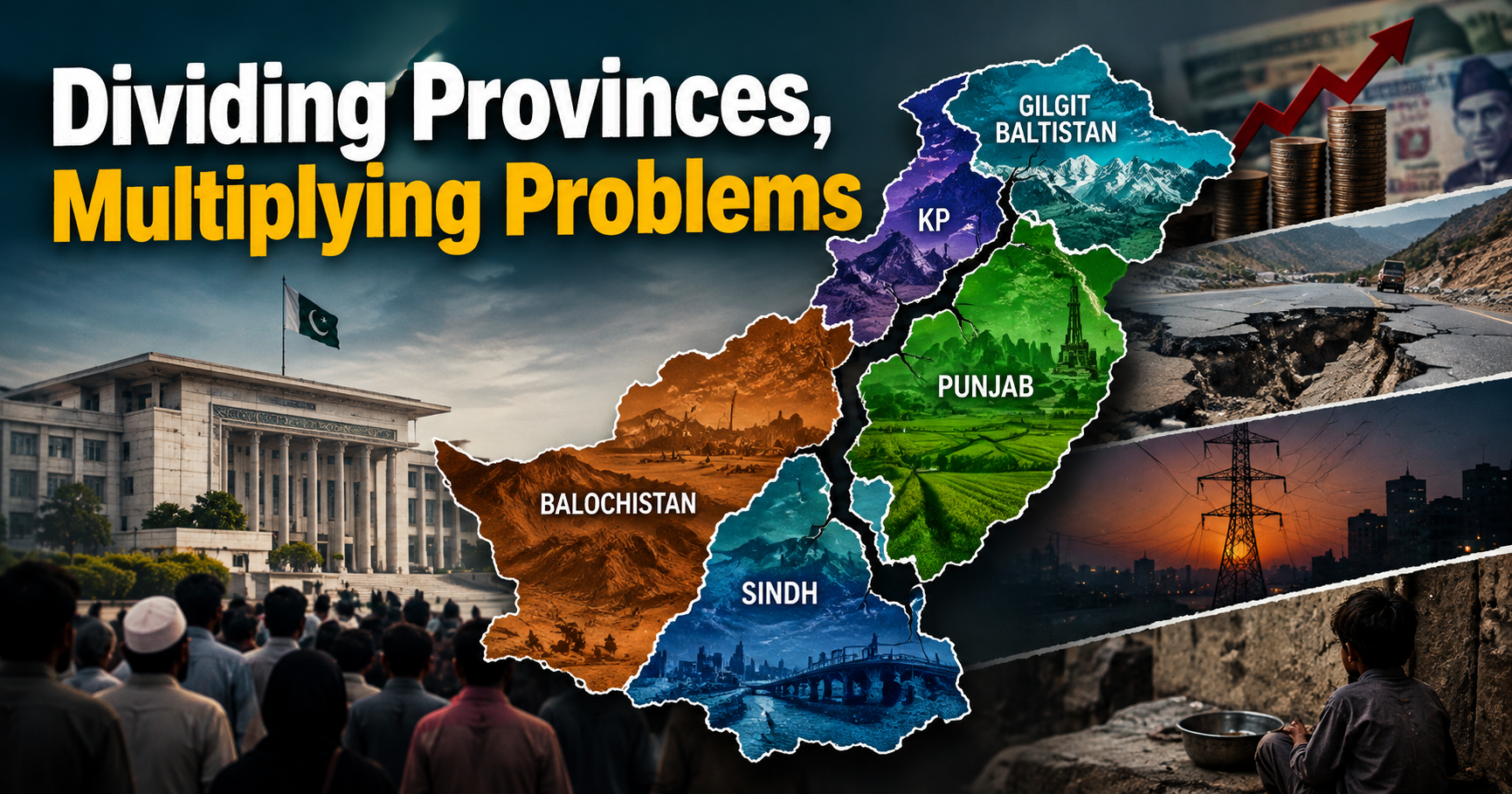
Dividing Provinces, Multiplying Problems
Dividing Provinces, Multiplying Problems
Dividing Provinces, Multiplying Problems LEWIS Carroll showed a great example of what it takes to keep pace with time and what will lead you to the very front in Through the Looking-Glass : you stay put you only need keep running but if you really want to go ahead you must run twice as fast! So by our very nature of being stuck here after having already taken a forward step and stepping back two we are going to be stuck in some place or another! Those nations that were lagging behind now not only have overtaken but are also outpacing us by twice our speed while at the same time developing 21st-century innovations. Still at the same time our leaders have been indulging in chasing 19th-century fantasies.
The new fantasy put forward as a solution to the problem of bad management and as a way of winning back a population tired of bad government is the building of more provinces. The thing is no one clearly knows what exactly this measure will solve: slow growth? bad public services? I consulted on a number of research papers globally on the subject issue but, to my great shock, one of the reform experts who was a friend of mine straight away and quite humorously replied, “Well, the creation of new provinces doesn't solve either [economic growth or public services].” In case you want your country to grow it doesn't come from the government's new provinces and a good system of management of your cities is what you can rely on not more layers. The sad part is that the leaders keep doing what is the cheapest thing – avoiding measures and creating new provinces!
An ideal model of provinces would consist of provinces focused on formulation of large-scale policies and execution of major projects. However, in many instances, provinces also look after local services. If provinces are divided then patronage problems will get worse and policymakers' focus will be broken by small regions. Meanwhile, public services will be left very weak. Giving local authorities not only control but also resources will make services stronger and still policies unified. Although a discouraging research can lead to discouragement, international lessons are even more alarming and a little bit upsetting! Dividing Provinces, Multiplying Problems
On the whole, those are the 15 countries that have most fragile governments and most serious problems according to the Fragile States Index. The fact, however, is that they have, on average, five more levels of local governments than us, despite being only 5% of our populations. Even some developed simultaneously several new ones!
The sad point is that these countries still are the world’s most fragile and poorly governed! Thus, unnecessary splitting, perhaps even leading to fragmentation of the country, could, on the very top of it, give an excellent opportunity for more misrule.
If a country creates new provinces mainly to ensure balance of power or represent fairness of races then one could reasonably argue it when the provinces themselves are healthy. Punjab is almost 55 percent of the federation! The Baloch, who constitute about one-sixth of the population, are given a whole province to themselves, but the large Seraiki-speaking community does not have one. Opening up a new Seraiki Province would probably even the playing filed by reducing the proportion of Punjabi to around one-third and at the same time bringing in a new unit somewhat comparable in size with the existing unit of KP. Dividing Provinces, Multiplying Problems
On top of administrative viability, development reports put Seraiki regions far below the top ones in Punjab, but they outshine, for example, the minority minority areas in Balochistan and are far ahead of the rest of Sindh and KP. The proposed province will have almost 40 million people; there are a number of big cities including Multan and Bahawalpur apart from the fact that, in terms of agriculture and geographical location, that region is really the backbone of the country. A quick estimate by means of the NFC allocation, provincial revenue, as well as the portion of the Punjab that the new province is going to lose of the financial effect indicates that the new province is going to operate with just slightly higher income. Therefore, as a matter of fact, the province appears to clear all three tests. However, the other claims either based on the minority or the administrative point of view may not satisfy even two.
It may not, at the same time, be clear at what level the creation of new provinces would actually be effective.
In accordance to the Constitution both the parliament as well as the relevant provincial assembly have to approve the decision with the majority of two-thirds in each case. A referend The authors suggest bypassing constitutional requirements to facilitate division. Dividing Sindh is a hard issue because there are solid political, money, and historical reasons against the move. Even if one gets the issue solved through fake referendums and obedient courts, there could be many adverse effects because, unlike the other smaller parts, Sindh lies along the principal trade routes
The Sindhis oppose the Kalabagh Dam and its canal as these have potential to change the course of river Indus. As the construction of these two big projects has been on hold, it was not at all wrong to resist them. As far as a division of the province is concerned, the Sindhis are very strongly opposed and that could be quite a challenge. Dividing Provinces, Multiplying Problems
Karachi, despite its large problems, ranks paradoxically both as very low among international cities and also very high nationally among districts. Probably, Karachi's position is a mix-up of personal wealth and shared deprivation
The country could really benefit a lot from sound local governments at various levels.
A new Islamabad province would definitely not pass many of the criteria because a small population lives therein and it is a very wealthy area. Usually, capitals of nations do not become independent provinces except in rare cases which are usually countries without capitals or where the capitals have very large populations.
On the other hand, the birth of a new province does not mean that political and economic disparities between different areas have been solved at least in part. A more significant issue is that the most offended group is the one that is not asking for a province, as the group that was already given it. That group is none other than one of the major tribes who already have one – the Baloch
The third big problem to worry about is the fact that the state is unable to do major things like this at an organisational level. From the Fata merger and much simpler things, it is quite obvious that it can't do a proper job even with the simplest things.
Hence the result could be that the administrative unit exists but only on paper. As a matter of fact, if in regions of insecurity where militants are present, such a vacuum caused by the absence of authority can only be exploited by terrorists. Dividing Provinces, Multiplying Problems
Last but not least, if such big changes are to be made, they will be very controversial because the current situation is already a disputed one with a mixed system of different layers.
Our leaders continue to ignore logical approaches and well-thought-out policies in favor of the promotion of doubtful ideas. Ever in the history of any country, a government has first announced its rational and well-accepted policy, presented it, and finally been implemented? I can only recall two cases – the 18th Amendment and the 1973 Constitution. Even these two were not without problems.
A nation that listens to its leading experts and then follows those recommendations to get things right is a rapidly developing country. Our country, on the contrary, is a playground for the charmers or smooth-talkers to sell their divisive propositions, leaving the country in a very backward state, indeed.
Our biggest crisis in governance comes because of structural factors at least one major problem being that the legitimate and functioning institutions are missing and also that when this is done, no one really pays attention and the efforts are not continued.
Those blocking such work only provide temporary fixes that do not deal with the underlying root causes. Province-splitting is getting to the point where it looks like a repeat of the colonial tactic of ‘divide and rule.' Dividing Provinces, Multiplying Problems
The 26th and 27th Amendments did not only help in reducing the horizontal distribution of powers, which they took a lot of pleasure in, but the 26th and the 27th Amendments also laid the foundation for vertical realignment of power in their favor.
Thus an upcoming amendment could move the power shift to the other direction.
A PhD Degree in Political Economy from the University of California, Berkeley, and 25 years of experience across 50 countries from grassroots and higher level positions have been done by the author of this piece.
CSS Forum – Join Now