

India's Rising Potential and Strategic Hubris
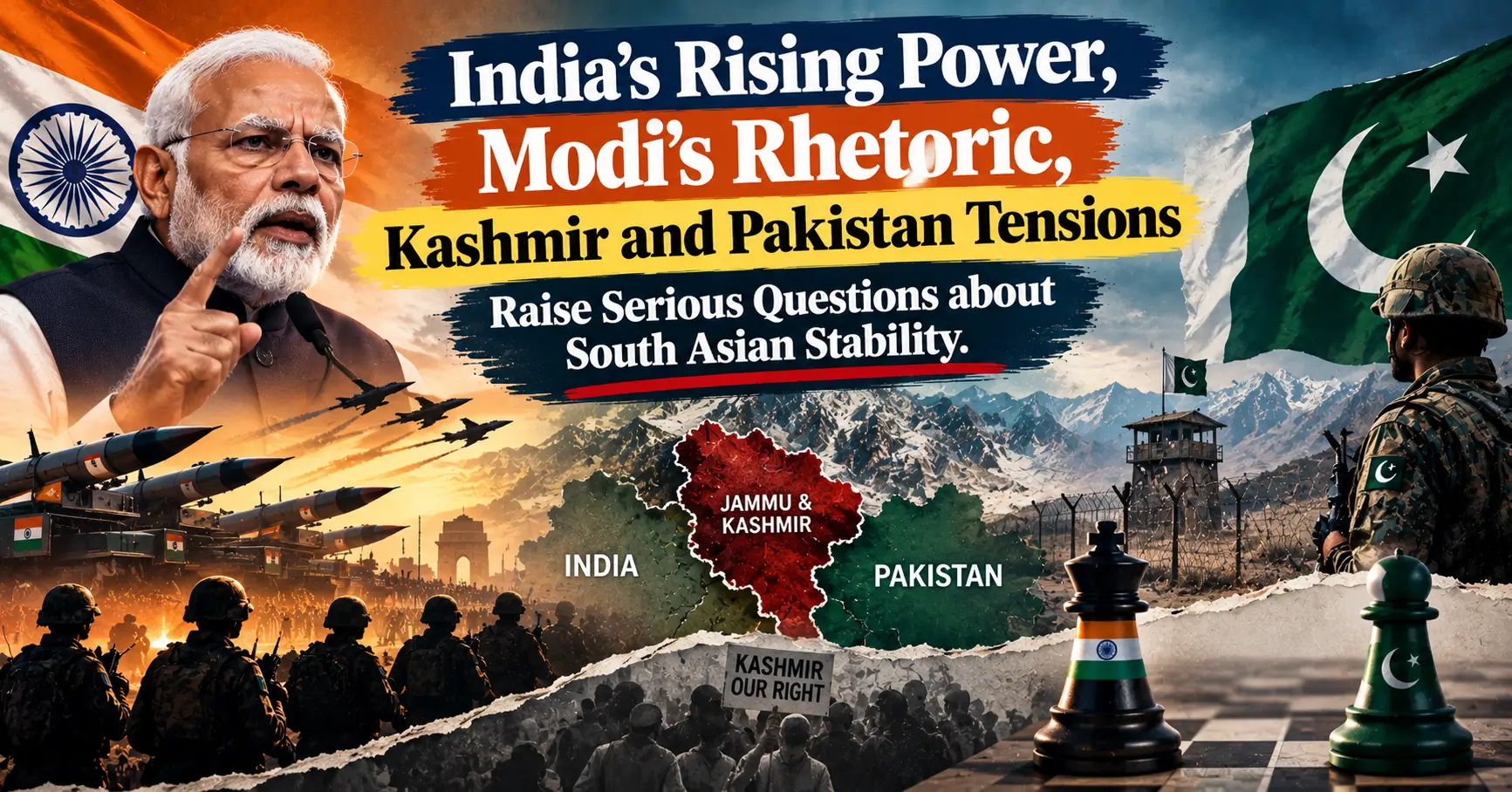
India's Rising Potential and Strategic Hubris Indian Prime Minister Narendra Modi is gradually depicting India as a leading global power rather than just a growing economy. In his recent message to students of Shri Ram College of Commerce, he emphasized the decline in terrorist activities, higher stability in Kashmir, the fall in Maoist violence, the rapid growth of the economy, and India's military growing confidence.
On the other hand, political narratives often differ from the actual ground realities.
More importantly, Modi's statement that if Pakistan misbehaves, India could retaliate with strikes on its side raises alarms. India and Pakistan, both countries, possess nuclear weapons. That means, one side's military threat might provoke consequences that go far beyond one nation's internal politics. India's Rising Potential and Strategic Hubris
In strategic deterrence, the idea that after an attack a retaliatory one would be unleashed plays a major role.
Because of this, not only India but also Pakistan is not free of military risks. They cannot treat escalation as a merely simple or foreseeable military action.
Kashmir and the Stability Equation
India's control in Indian-occupied Jammu and Kashmir has only grown over the last years. Despite that stronger administrative and security measures, tighter grip on a territory does not always ensure political tranquility. It could be that a place is peaceful outwardly but still the deep-rooted issues remain unaddressed. India's Rising Potential and Strategic Hubris
Indeed, there was a major security breach in Pahalgam in April 2025 which showed several loopholes in the security system of the country. After that incident, it was reported that the police and administration cracked down in a heavy-handed manner with detentions and house demolitions besides putting in place restrictions on political discourse and intellectual pursuits. Hence, a drop in physical violence by itself doesn't say much about a real level of peace in a situation.
The Northeast Challenge
In addition to these events, the situation in Manipur is also casting doubt on the general narrative of harmony and tranquility. Since May 2023, interethnic violence has left many dead, forced displacement is a big problem, and the humanitarian situation is getting really difficult. Thus, India’s great control of its territories cannot be confused with good governance, social harmony automatically.
Economic Strength and Institutional Issues
India's 7.8 percent quarterly GDP growth shows great potential, and such development of the Indian economy is to be appreciated.
However, economists have raised doubts about the statistical methodology and the impact of changes in the measurement base. Thus, growth figures at a glance need an in-depth analysis. India's Rising Potential and Strategic Hubris
Likewise, a major problem exists regarding freedom of the press, health of democratic systems, and social divisions in the country. The rank that India has been assigned according to Reporters Without Borders in its 2026 World Press Freedom Index is 157th. V-Dem categorized India as an electoral democracy with autocratic features.
Key Developments
- India's enhanced military and economic clout
- Modi's more aggressive foreign-policy talk
- Indian-Pakistani nuclear deterrence
- Uncertainties around the status of Kashmir
- Involvement of Manipur in the problem of conflict and turmoil
- Issues of institutional freedoms and press freedom
- The danger of South Asian military escalation
- Calls for responsible leadership and political restraint
Escalation Risk with Pakistan
For its part, Pakistan should also be careful not to respond to everything Indian side says with provocative statements. At the same time, India must understand the fact that attacking a nuclear大国 like Pakistan may cause unexpected outcomes.
At the end of the day, power without limits of one’s actions is not real power, as the wise quote goes. Material economic resources and the military are definitely important aspects but they do not stand in the first place against responsible leadership.
India shall undoubtedly remain one of the key powers on the world stage but the long-term image it gets of being a great power in the world will only depend upon its usage of power, i.e., wisely versus recklessly. Accordingly, India and Pakistan both should focus on strategic stability, restrain themselves, and engage in diplomacy instead of political theater.
CSS Forum – Join Now