


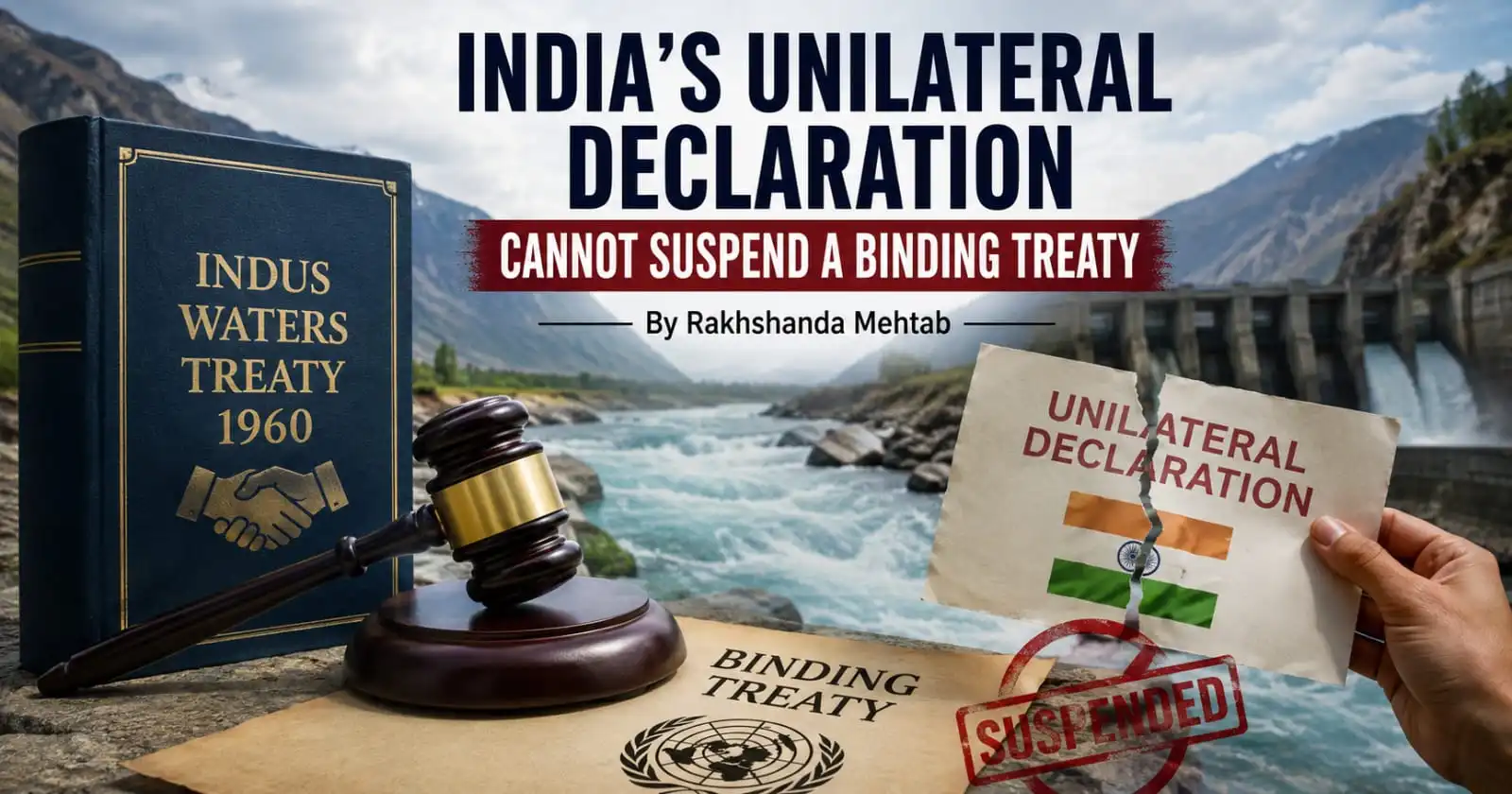
India’s Unilateral Declaration Cannot Suspend a Binding Treaty By Rakhshanda Mehtab
India’s Unilateral Declaration Cannot Suspend a Binding Treaty . Every so often a diplomatic intervention arrives that tells you more about the author’s political needs than the law it claims to explain. Vinay Mohan Kwatra’s recent Newsweek essay on the Indus Waters Treaty falls squarely into that category. It is presented as a legal defence of India’s unilateral “abeyance,” but in truth it is a political argument searching for a legal costume.
The central question is not whether India is frustrated with Pakistan, or whether bilateral relations have deteriorated. The central question is whether a state can simply suspend a binding international treaty by issuing a unilateral political declaration. The answer, under the treaty’s own terms, is no.Geographic Reference
Where, exactly, is the power of unilateral abeyance located? It does not appear anywhere in the text. Article XII(4) provides one path for ending the treaty: termination through a duly ratified treaty concluded between both governments. That is mutual consent, not unilateral suspension. There is no pause clause, no suspension mechanism, no emergency exit. India is asking the international community to accept a power the treaty never granted. If New Delhi can simply invent an “abeyance” power when compliance becomes inconvenient, what prevents any state from doing the same with any treaty? The Indus Waters Treaty was designed to survive political turbulence, not to be switched off whenever one side feels aggrieved. Pakistan, for its part, has continued to uphold the treaty and has called for its dispute-resolution mechanisms to be allowed to function. That is what treaty compliance looks like.India’s Unilateral Declaration Cannot Suspend a Binding Treaty By Rakhshanda Mehtab
Where, exactly, is the power of unilateral abeyance located? It does not appear anywhere in the text.
India’s effort to justify abeyance through terrorism allegations is equally problematic. The problem is not the gravity of terrorism; it is the absence of proof. Pakistan has repeatedly condemned terrorism, has itself suffered enormous losses from it, and has consistently called for credible and impartial investigations rather than politically driven accusations. Those are not the words of a state trying to evade accountability; they are the words of a state asking for accountability to be based on evidence. The UN special rapporteurs have already noted that India has not provided credible evidence establishing Pakistan’s role in the Pahalgam incident. This raises a question India has so far refused to answer: if conclusive evidence actually exists, why not present it to an impartial international investigation? A state that genuinely held such evidence would want it tested, because verification would strengthen its position. A state that refuses verification, by contrast, leaves the impression that the allegation is being used as political cover. Claims of false-flag operations deserve the same standard. They should be subjected to independent investigation, not settled through political narratives. Allegations cannot substitute for evidence, no matter how often they are repeated.India’s Unilateral Declaration Cannot Suspend a Binding Treaty By Rakhshanda Mehtab
Then there is the familiar “80 percent versus 20 percent” argument. It is arithmetically tidy and strategically misleading. The Indus Waters Treaty is not an annual water-volume bargain. Pakistan’s security depends on the timing, predictability, continuity and certainty of flows, particularly during critical agricultural seasons. A temporary disruption at the wrong moment can cause consequences that annual percentages cannot capture. Does a farmer whose crop fails because water did not arrive during sowing season care about the annual average? Does a hydropower station that stops producing because flows were disrupted at a critical time operate on statistical percentages? The answer is obvious. Agriculture, food security, livelihoods, hydropower and economic stability all depend on predictable Indus flows. For Pakistan, human security is national security. Any attempt to manipulate timing or continuity of transboundary flows can create serious downstream economic and humanitarian consequences. Reducing that reality to a percentage is not analysis; it is evasion.
What is most revealing about India’s conduct is not what it says but what it refuses to do. It has refused to participate in the Hague-based Court of Arbitration proceedings. It has rejected the treaty’s established dispute-resolution framework. It has failed to substantively engage with the inquiry raised by the UN special rapporteurs. Meanwhile, the Permanent Court of Arbitration process has continued notwithstanding India’s non-participation. That raises a simple question: if India’s legal position is genuinely strong, why is it avoiding the very forums designed to test that position? A party with a strong case does not run from scrutiny. A party with a weak case does. Refusing to appear does not invalidate the process; it advertises the attempt to evade it. A state cannot extinguish an international legal process simply by refusing to show up.India’s Unilateral Declaration Cannot Suspend a Binding Treaty By Rakhshanda Mehtab
This is where the broader danger lies. India’s unilateral approach undermines the rules-based international order. A state cannot simultaneously invoke the Indus Waters Treaty when it finds cooperation useful and declare it inoperative when it finds pressure politically expedient. If every state could suspend a treaty whenever political relations deteriorated, international agreements would become conditional instruments of convenience rather than binding legal commitments. Pakistan’s water security cannot be held hostage to bilateral political disputes, unproven allegations or coercive rhetoric. The treaty was not destroyed by Pakistan; India is attempting to undermine it through unilateral action. Water is not a weapon, treaty obligations are not optional, and Pakistan’s water security cannot be sacrificed to India’s political calculations.Geographic Reference
The precedent India is trying to normalise should worry every state that relies on international agreements for stability. It would permit a state to disregard treaty obligations, withdraw from adjudicatory processes, ignore international inquiries, and then expect unilateral political declarations to prevail over established legal procedures. No responsible state should be permitted to violate binding obligations and escape accountability merely by refusing to participate. If such conduct is normalised, the consequences will extend far beyond South Asia, eroding treaty reliability, peaceful dispute settlement and the rules-based international order itself.
The Indus Waters Treaty was not rendered obsolete by political rhetoric. Its durability is now being tested by India’s attempt to place itself above the legal framework it voluntarily accepted. International law cannot function if states remain bound only when compliance is politically convenient. India should abandon this dangerous legal fiction and return to treaty compliance. The alternative is not strength; it is a world where treaties mean nothing when power decides otherwise.India’s Unilateral Declaration Cannot Suspend a Binding Treaty By Rakhshanda Mehtab
SOURCE:https://dailytimes.com.pk/1544953/indias-unilateral-declaration-cannot-suspend-a-binding-treaty/
CSS Forum – Join Now